Soft Spots in Induction Hardening: Causes & Fixes
Understand what causes soft spots in induction hardening — and the proven process controls that eliminate them for uniform surface hardness on gears, shafts and axles.
By the Thakur Industries Metallurgy Team · Reviewed by the Heat-Treatment Process Engineering Team
Published 4 March 2026 · Updated 13 June 2026
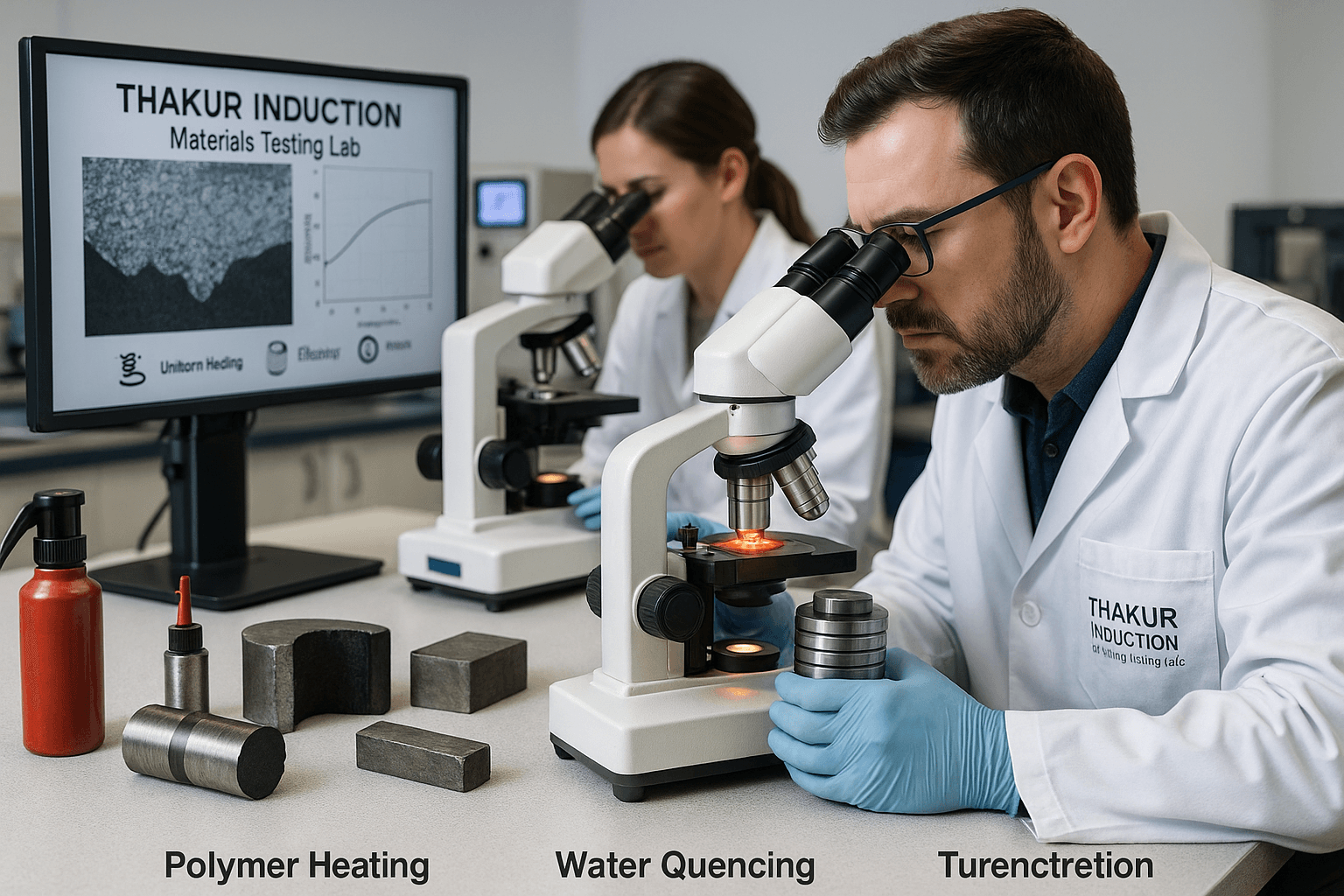
The short answer: soft spots in induction hardening are caused by non-uniform heating or cooling — most often poor coil design or misalignment, inconsistent scanning speed and power, uneven quench flow, surface contamination, or variation in the steel grade. Each leaves a localized zone that never fully transforms to martensite, so it stays softer than the surrounding case.
What Are Soft Spots in Induction Hardening?
Soft spots are localized regions of reduced hardness on a metal surface after the induction hardening process. They occur when heating, quenching, or metallurgical transformation doesn’t happen uniformly. These imperfections reduce the wear resistance, fatigue strength and load-bearing capacity of a component, compromising the reliability of gears, shafts, axles and other critical parts — and they typically become the very point where pitting or fatigue cracking begins.
At a glance, the main causes of soft spots are:
- Coil design or alignment — an unbalanced field leaves cool, under-hardened zones.
- Inconsistent scanning speed or power — areas never reach the austenitizing temperature.
- Uneven quench — patchy flow or pressure means parts of the surface cool too slowly.
- Surface contamination — oil, scale or oxide blocks uniform heat absorption.
- Material variability — inconsistent carbon or alloy content gives inconsistent hardness.
And the fixes that eliminate them:
- Geometry-specific, calibrated coil design.
- Constant, PLC-controlled scanning speed and power.
- Uniform quench flow and pressure from automated systems.
- Thorough pre-cleaning and degreasing before treatment.
- Verified steel grade plus full digital parameter logging.
Top Causes of Soft Spots — and How to Prevent Them
Three causes account for the large majority of soft spots in real production: coil design, scanning speed and quench uniformity. Get those three right and most defects disappear. The table below maps each common cause to the fix we apply at Thakur Industries.
| Cause | Solution at Thakur Industries |
|---|---|
| Improper Coil Design or Alignment | Use custom-designed coils calibrated for each component’s geometry to ensure balanced heat distribution. |
| Inconsistent Scanning Speed, Power or Frequency | Employ PLC-controlled scanning speed and power regulation for consistent electromagnetic penetration along the whole surface. |
| Surface Contamination or Oxidation | Perform pre-cleaning and degreasing of every component before induction treatment. |
| Non-Uniform Quenching | Use automated polymer and water quenching systems with controlled flow pressure for consistent cooling coverage. |
| Material Composition Variability | Conduct material certification and testing before processing to verify steel grades. |
| Improper Tempering or Post-Heat Stress | Apply precision tempering to stabilize the microstructure and eliminate stress gradients. |
Coil design and alignment
The induction coil shapes the magnetic field. If it doesn’t match the component geometry — or sits at an uneven coil-to-surface distance — some areas heat less and never reach the austenitizing temperature. A coil designed and aligned for the specific part is the single most important defence against soft spots. See our deeper look at the induction hardening process for how coil and frequency selection interact.
Scanning speed and power
In scan hardening, the part (or coil) traverses at a set speed. If that speed is inconsistent or too fast, the surface dips below the transformation temperature in places, leaving untransformed, soft bands. Constant, PLC-controlled scanning speed and power keep the whole surface within the correct heating window.
Quench uniformity
Even with perfect heating, a patchy quench undoes everything: any spot that cools too slowly misses the martensite window and stays soft. Automated quenching with controlled flow and pressure delivers consistent cooling across the whole surface. The same discipline also prevents related defects — see how we prevent cracks and control distortion.
Need consistent, soft-spot-free hardening in Ludhiana? Get a quote
Thakur Industries, Ludhiana delivers fully verified, uniform-hardness induction hardening for gears, shafts and transmission parts — every parameter logged for traceability and quality audits.
How to Prevent Soft Spots: Best-Practice Checklist
Eliminating soft spots is a process-discipline problem, not luck. The five-step routine below is what we follow on every job to guarantee uniform surface hardness.
| Step | Action | Purpose |
|---|---|---|
| Pre-Cleaning | Remove oil, dust, oxide | Uniform heating |
| Coil Calibration | Set distance & symmetry | Balanced heat coverage |
| Scanning & Frequency Optimization | Match speed and frequency to material grade | Accurate, even case depth |
| Controlled Quenching | Maintain flow & pressure | Even cooling |
| Hardness Testing | Verify 100% coverage | Detect soft spots early |
At Thakur Industries, Ludhiana we combine advanced equipment and process discipline to eliminate induction hardening defects. Our day-to-day controls include:
- Computerized temperature monitoring during heating cycles
- Real-time coil-to-surface distance and scanning-speed control
- Digital quenching flow meters for pressure consistency
- Case depth verification (metallographic inspection)
- Hardness testing (Rockwell, Vickers and microhardness)
Every process parameter is logged digitally for traceability and quality audits.
Case-depth and hardness acceptance criteria follow the heat-treatment standards summarised by ASM International.
Case study: eliminating soft spots in automotive gear shafts
An automotive OEM in Ludhiana faced non-uniform hardness (soft zones near spline ends) in an EN19 gear shaft. Our analysis found inconsistent heating due to coil misalignment and uneven quenching flow. By redesigning the coil geometry, adjusting quenching spray angles and calibrating the system for a consistent 20 kHz frequency, we achieved uniform surface hardness of 58.5–59.5 HRC and eliminated all soft spots, improving component life by 30%. The same controls underpin our gear hardening and shaft hardening services.
How We Test for Soft Spots
Detecting a soft spot before a part ships is as important as preventing it. We verify uniform hardness with a layered inspection regime:
- Multi-point hardness testing — Rockwell, Vickers and microhardness readings across the surface, not just one spot.
- Metallographic case-depth inspection — a sectioned sample confirms an even martensitic case.
- Non-destructive scanning — eddy-current or magnetic comparator checks flag any low-hardness zone on production lots.
- Full digital traceability — every reading is logged against the job for audit and OEM sign-off.
This catch-it-early approach means a soft spot is found and corrected in process, not discovered by the customer in the field.
Frequently Asked Questions
What causes soft spots in induction hardening?
Soft spots are caused by non-uniform heating or cooling. The most common causes are poor coil design or misalignment, inconsistent scanning speed or power, uneven quench flow, surface contamination such as oil or scale, and variation in the steel’s composition. Any of these prevents a complete martensitic transformation in localized areas, leaving them softer than the surrounding surface.
How do you prevent soft spots in induction hardening?
Prevent soft spots with a coil designed for the part geometry, a constant scanning speed and power, a clean degreased surface, and a uniform quench at controlled flow and pressure. Verifying steel grade before processing and logging every parameter digitally ensures repeatable, soft-spot-free results.
How do you test for soft spots after hardening?
Soft spots are detected with multi-point hardness testing (Rockwell, Vickers and microhardness), metallographic case-depth inspection of a sectioned sample, and, for production lots, non-destructive eddy-current or magnetic comparator scanning that flags any low-hardness zone before delivery.
Are soft spots a serious defect?
Yes. A soft spot is a localized region of low hardness that reduces wear resistance, fatigue strength and load-bearing capacity. On gears, shafts and axles it becomes the point where pitting, spalling or premature failure begins, so soft spots must be eliminated, not just minimized.
Does scanning speed affect soft spots?
Yes. In scan hardening, an inconsistent or too-fast traverse speed leaves the surface below the austenitizing temperature in places, so those areas never transform to martensite and stay soft. A constant, correctly calibrated scanning speed matched to the part is essential for uniform hardness.
Need Reliable, Defect-Free Induction Hardening?
Get in touch with Thakur Industries, Ludhiana — specialists in precision heat treatment with verified, soft-spot-free hardening for OEMs across Punjab, Haryana and Delhi NCR.