How to Prevent Cracks in Induction Hardening
To prevent cracks in induction hardening, control the full cycle: preheat to cut the thermal gradient, hold heat below grain-coarsening limits, quench with polymer at a controlled rate and temperature, then temper promptly. Match the process to the steel grade and ease sharp geometry that concentrates stress. At Thakur Industries, Ludhiana, every part is inspected for micro-cracks before dispatch.
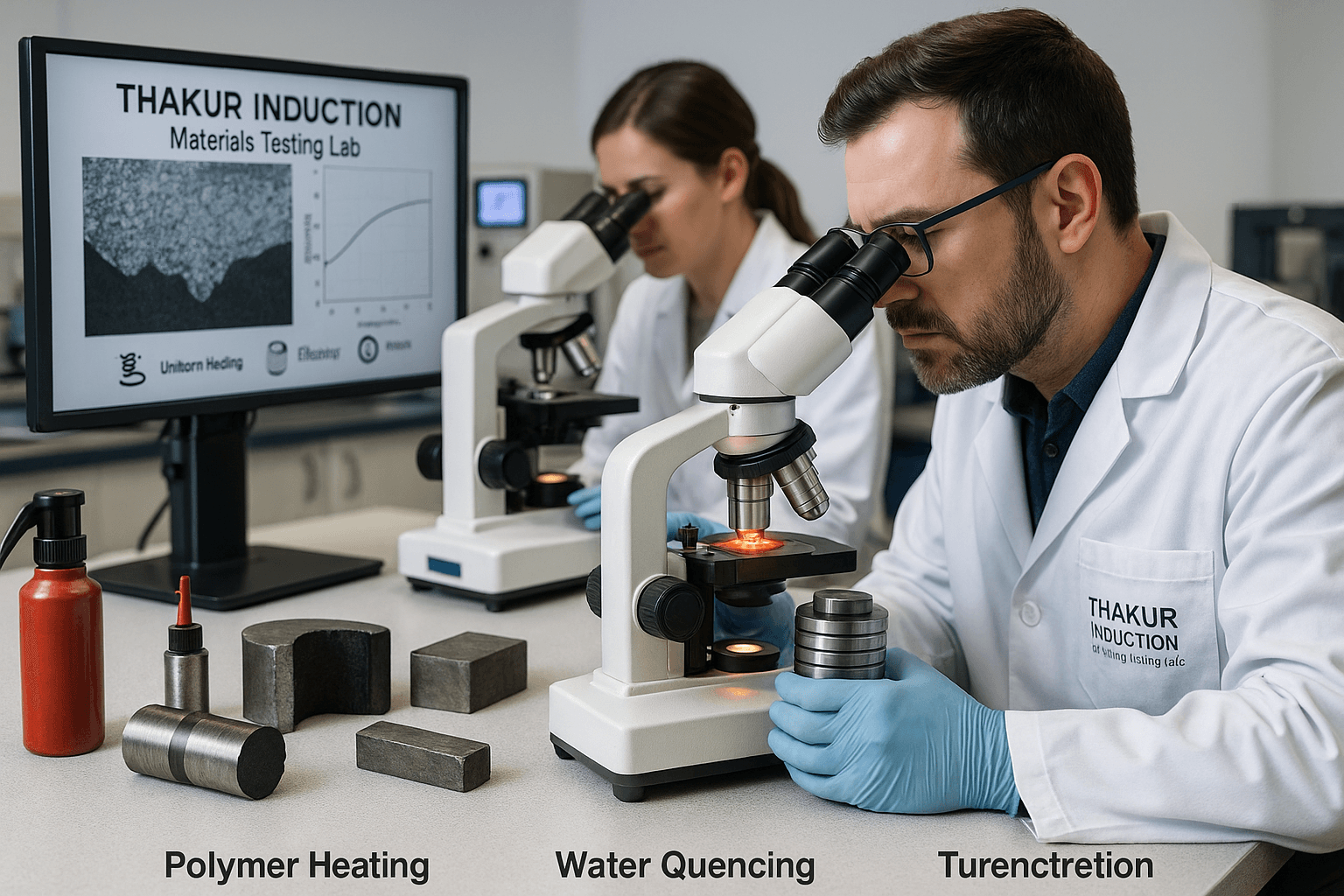
Induction hardening gives components high surface hardness and excellent wear resistance, but its biggest quality risk is surface cracking — fine fractures that appear after heat treatment or during service. These cracks usually stem from thermal shock, residual stress or an over-aggressive quench, and they can cause premature failure of shafts, gears and other critical parts. The good news: every cause has a corresponding fix.
Crack causes and their fixes (quick reference)
Use this numbered cause-to-fix list as a fast diagnostic when you see cracking:
- Cause: Overheating past the critical temperature. Fix: Use closed-loop power and time control to hold the austenitising window and avoid grain coarsening.
- Cause: Too rapid a quench. Fix: Switch from water to a polymer quench (8–12%) at a controlled 25–35°C to soften the cooling shock.
- Cause: High-carbon or alloy steel left untempered. Fix: Temper promptly at 150–200°C to relieve residual stress before micro-cracks propagate.
- Cause: Sharp edges and abrupt section changes. Fix: Add generous fillet radii and de-burr edges to spread stress instead of concentrating it.
- Cause: Non-uniform heating or cooling. Fix: Use a coil designed for the part geometry and a 360° quench for even case depth.
Why cracks form during induction hardening
Cracking occurs when the stresses from rapid heating and cooling exceed the metal’s tensile strength. The sudden temperature difference between the hot surface and the cooler core drives uneven expansion and contraction, while the volume change as austenite transforms to martensite adds further stress. Here are the main causes and their effects:
| Cause | Effect |
|---|---|
| Overheating beyond the critical temperature | Grain coarsening and brittle surface layer |
| Too rapid quenching | Thermal shock and micro-cracks |
| High carbon or alloy steel without tempering | Brittle martensite formation |
| Sharp edges or geometry transitions | Localized stress concentration |
| Non-uniform heating or cooling | Uneven case depth and residual stress |
Controlling each stage — heating, holding and quenching — is essential for crack-free results. Cracking is closely related to its sister defect, distortion; our guide on how to prevent distortion in induction hardening covers the stress side of the same problem.
Preheat & quench control
Heating and quenching are where most cracks are won or lost. A gradual, controlled heating ramp — set with programmable power and time — keeps the surface-to-core gradient low so contraction is even. For crack-prone grades, a short preheat further reduces thermal shock before the part reaches its austenitising temperature.
Quenching is the single most critical stage for crack control. At Thakur Industries, we follow strict quench management protocols:
| Parameter | Control Strategy |
|---|---|
| Quench Type | Polymer (8–12%) preferred over water |
| Flow Rate | Uniform, 5–8 L/min per nozzle |
| Quench Angle | 360° surround for shafts and gears |
| Temperature Control | Quench temperature maintained between 25–35°C |
| Agitation | Continuous flow to avoid vapor blanket formation |
Consistent cooling prevents uneven contraction and residual-stress build-up. The choice of medium matters: see polymer vs water quenching for why a controlled polymer quench is gentler than plain water for most alloy steels.
Material & geometry factors
Even a perfect heating and quenching cycle can crack the wrong part. Two factors decide how much margin you have before the steel reaches its limit:
- Material chemistry: Higher carbon and alloy content (EN24/4340, high-carbon grades) form harder, more brittle martensite that is more prone to quench cracking. These grades demand a gentler quench and prompt tempering.
- Geometry and stress raisers: Sharp corners, keyways, oil holes and abrupt section changes concentrate stress and become crack initiation sites. Generous fillet radii and clean, de-burred edges spread the load.
- Prior condition: Decarburised, contaminated or already-stressed surfaces crack more easily. Clean parts and a stress-relieved starting condition improve every result.
We tune the process for the part: precision shafts and axles run through our shaft hardening line, while teeth-critical work runs on our gear hardening line, each with geometry-matched coils and quench setups.
Need crack-free induction hardening in Ludhiana? Get a quote
Share your drawing and steel grade — our team at Thakur Industries, Ludhiana will recommend the right quench, tempering and inspection plan for crack-free parts.
Prevention checklist
Run through this numbered checklist on every crack-sensitive job at Thakur Industries:
- Controlled heating rate — gradual, programmable power and time to cut thermal stress.
- Geometry-matched coil design — even energy distribution across the part profile.
- Optimised quench — polymer for sensitive grades, multi-zone or 360° spray for larger parts.
- Prompt tempering — 150–200°C to relieve residual stress and avoid delayed cracking.
- 100% inspection — magnetic-particle or dye-penetrant testing to catch micro-cracks before dispatch.
For a related failure mode driven by uneven heating, see preventing soft spots in induction hardening. Crack-free results come from engineering discipline backed by verified quality certifications — not trial and error.
Frequently asked questions
Why do cracks form during induction hardening?
Cracks form when the stress from rapid heating and quenching exceeds the steel’s tensile strength. The hot surface contracts faster than the cooler core, and the volume change as austenite transforms to martensite adds further stress. Overheating, over-aggressive quenching, high-carbon steel without tempering and sharp geometry all raise the risk.
Does preheating prevent cracking?
Yes. A controlled, gradual heating ramp lowers the thermal gradient between surface and core, so contraction is more even and residual stress is reduced. For high-carbon and alloy grades, preheat combined with prompt tempering is one of the most effective ways to avoid quench cracks.
Which quench medium is least likely to cause cracks?
A polymer quench at 8–12% concentration, held at 25–35°C with uniform flow, cools more gently than plain water and greatly reduces thermal shock. Water quenching extracts heat too aggressively for many alloy steels and is a common cause of quench cracking.
Can cracked induction-hardened parts be repaired?
Quench cracks are through the hardened case and cannot be reliably repaired; the part should be rejected. The right approach is prevention through controlled heating, optimised quenching, prompt tempering and 100% magnetic-particle or dye-penetrant inspection before dispatch.
Conclusion: precision is the best crack prevention
Preventing cracks in induction hardening is about complete process control, not quenching alone. From coil design and a controlled heating ramp to quench management, prompt tempering and final inspection, every step must work together. At Thakur Industries, we have perfected this balance to deliver crack-free, distortion-free, high-performance components to manufacturers across Ludhiana and Punjab. For authoritative background on quench cracking and residual stress, the ASM International heat-treating references are an excellent resource.
Facing cracks or distortion in your components?
Partner with Thakur Industries, Ludhiana — specialists in surface stress control, polymer quenching and advanced heat treatment services.