How to Prevent Distortion in Induction Hardening
Published June 2026•Updated June 2026
To prevent distortion in hardening, control how heat goes in and comes out: use a coil engineered for the part, ramp temperature gradually, quench in polymer rather than plain water, add preheat and temper cycles, and hold the part in symmetrical fixturing. Together these levers keep components dimensionally accurate.
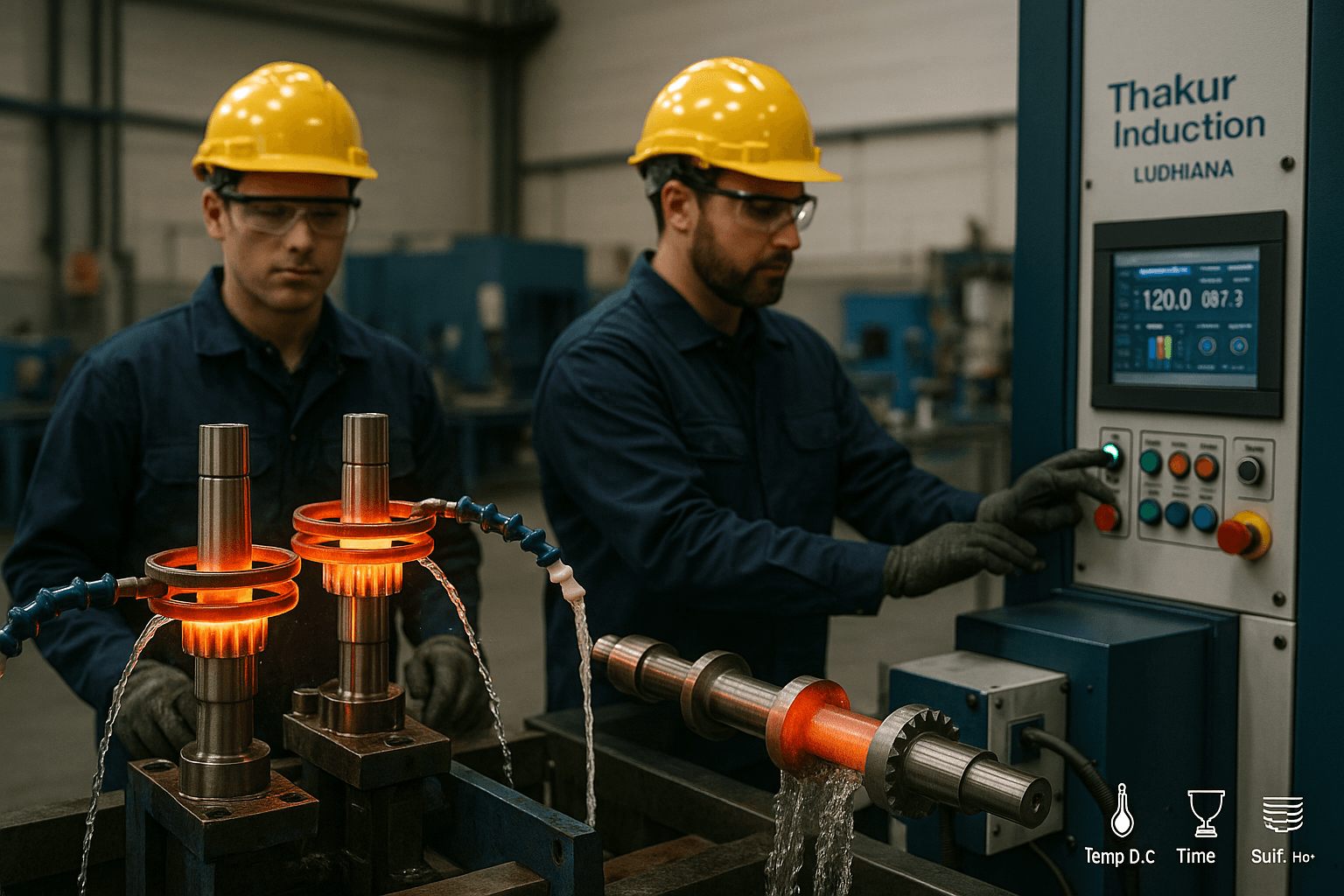
Induction hardening is the go-to process for improving wear resistance and fatigue strength in steel components. But one of the biggest challenges engineers face is distortion — the unwanted warping or dimensional change that occurs during heating and quenching. At Thakur Industries (Ludhiana), we specialize in induction hardening distortion control, using process design, coil engineering and quenching technique to achieve uniform hardness with minimal shape deviation across Punjab.
Why Distortion Happens
Distortion occurs because uneven heating, steep thermal gradients and rapid cooling set up internal stresses inside the metal. When one region expands or contracts faster than its neighbour, the part bends, twists or grows out of tolerance. The four most common causes are:
| Root cause | Why it distorts the part |
|---|---|
| Non-uniform heating | Hot and cold zones expand at different rates, warping the part. |
| Incorrect quench rate | Too-fast cooling locks in steep thermal stresses and bending. |
| Material inconsistencies | Uneven composition or prior structure responds unevenly to heat. |
| Improper fixturing | Unbalanced support lets the part sag or twist as it heats and cools. |
Because induction hardening is localized, it already distorts far less than full-furnace methods — see our induction hardening process guide for how that localization works. The remaining distortion is what disciplined process control removes.
7 Ways to Prevent Distortion in Induction Hardening
Follow these seven steps, in order, to keep hardened parts dimensionally accurate. The first five are the core levers; the last two keep the process repeatable batch after batch.
- Engineer the coil to the part geometry — A coil matched to the part’s shape delivers balanced heat flow, so no single zone overheats and warps. Custom coil design is the single biggest lever for distortion control.
- Control the heating parameters — A gradual, uniform temperature rise minimizes thermal shock and steep gradients. Frequency, power density and heating time are tuned so the case reaches austenite evenly.
- Use polymer quenching for a gentler cool — A controlled polymer quench cools more gently than plain water, reducing thermal stress and cracking while still forming a hard martensitic case.
- Add preheating and tempering cycles — Preheating narrows the temperature gradient before hardening, and a post-quench temper relieves internal stresses that would otherwise pull the part out of shape.
- Hold the part in symmetrical fixturing — Symmetrical, balanced fixturing keeps heating and cooling even around the part, preventing the localized distortion that uneven support creates.
- Start with consistent, qualified material — Material inconsistencies cause uneven response to heat. Verifying composition and prior microstructure keeps results repeatable from part to part and batch to batch.
- Verify with in-house testing and feedback — Measuring runout, case depth and microhardness on every batch confirms the process is in control and feeds corrections back into coil, heating and quench settings.
Distortion and cracking share the same root cause — uncontrolled thermal stress — so the same discipline pays off twice. For the failure-mode angle, read how to prevent cracks in induction-hardened components and preventing soft spots in induction hardening. For the underlying metallurgy, the ASM International heat treating resources are an authoritative reference.
Need distortion-controlled hardening in Ludhiana? Get a quote
Send us your part drawings and steel grade — we will recommend the coil, heating and polymer-quench settings to hold tight tolerances, with fast turnaround across Ludhiana and Punjab.
Fixturing & Process Control
Fixturing is where good intentions become measurable results. The part must be supported symmetrically so heat enters and leaves evenly — an unbalanced fixture lets a shaft sag or a gear twist before the case has even set. Rotating fixtures keep round parts concentric to the coil so the heated band stays uniform all the way around.
Process control then locks those gains in. We treat the four core settings as a linked system rather than independent dials:
Engineer the coil to the part geometry
A coil matched to the part’s shape delivers balanced heat flow, so no single zone overheats and warps. Custom coil design is the single biggest lever for distortion control.
Control the heating parameters
A gradual, uniform temperature rise minimizes thermal shock and steep gradients. Frequency, power density and heating time are tuned so the case reaches austenite evenly.
Use polymer quenching for a gentler cool
A controlled polymer quench cools more gently than plain water, reducing thermal stress and cracking while still forming a hard martensitic case.
Add preheating and tempering cycles
Preheating narrows the temperature gradient before hardening, and a post-quench temper relieves internal stresses that would otherwise pull the part out of shape.
Hold the part in symmetrical fixturing
Symmetrical, balanced fixturing keeps heating and cooling even around the part, preventing the localized distortion that uneven support creates.
The same control that prevents distortion also protects hardness uniformity — the goal is a tough core with a clean, even case. See our gear hardening and shaft hardening services for how we apply this to specific part families, and our quality certifications for the testing behind every batch.
Case Study: Distortion Control in EN19 Shafts
A Ludhiana-based automotive OEM faced recurring shaft bending of 0.4–0.6 mm after hardening on conventional furnaces. After switching to induction hardening at Thakur Industries with a custom coil, controlled heating and polymer quenching, the results were:
| Surface Hardness | 56 HRC |
| Case Depth | 3.2 mm |
| Final Runout | <0.05 mm |
| Reject Rate Reduced | from 12% to 1% |
Result: uniform hardness and distortion-free components ready for OEM assembly.
Why Choose Thakur Industries for Precision Heat Treatment
| Feature | Advantage |
|---|---|
| Advanced Induction Systems | Medium & high-frequency precision control |
| Polymer Quenching Setup | Controlled cooling for distortion prevention |
| Custom Coil Engineering | Perfect heating distribution |
| In-house Testing Lab | Case depth & microhardness verification |
| Experienced Metallurgical Team | 10+ years of process optimization |
| Local Service Network | Fast turnaround across Punjab & NCR |
Distortion-free induction hardening is not luck — it is science, process and control. By combining intelligent coil design, controlled heating parameters and polymer quenching, Thakur Industries delivers uniformly hardened, dimensionally stable parts trusted by Punjab’s top automotive and engineering industries.
Frequently Asked Questions
What causes distortion during induction hardening?
Distortion is caused by uneven heating, steep thermal gradients and rapid cooling, which set up internal stresses inside the part. Common contributors are non-uniform heating, an incorrect quench rate, material inconsistencies and improper fixturing.
How do you prevent distortion in hardening?
You prevent distortion by controlling heat input and cooling: use a coil engineered for the part geometry, ramp temperature gradually, choose polymer quenching for a gentler cool, add preheat and temper cycles, and hold the part in symmetrical fixturing so it heats and cools evenly.
Does polymer quenching reduce distortion compared with water or oil?
Yes. A correctly mixed polymer quench gives a more controlled, gentler cooling rate than plain water, which lowers thermal stress and cracking risk while still forming a hard martensitic case.
How much distortion can be eliminated with proper process control?
With engineered coils, controlled heating and polymer quenching we have taken EN19 shafts from 0.4–0.6 mm bend after conventional furnace hardening down to under 0.05 mm runout, cutting the reject rate from 12% to 1%.
Where can I get distortion-controlled induction hardening in Ludhiana, Punjab?
Thakur Industries provides distortion-controlled induction hardening, polymer quenching and in-house case-depth and microhardness testing across Ludhiana and Punjab, with fast turnaround for OEM and job-work parts.
Looking for Distortion-Free Induction Hardening in Punjab?
Partner with Thakur Industries, Ludhiana for precision-controlled induction hardening and polymer quenching with case-depth and microhardness testing on every batch.