Induction Hardening Process: Step-by-Step Guide
Published June 2026•Updated June 2026
The induction hardening process runs in five steps: prepare and clean the component, heat its surface with an induction coil to 850°C–950°C, quench it rapidly to form hard martensite, temper it to relieve stress, then inspect hardness and case depth. The result is a tough core with a wear-resistant case.
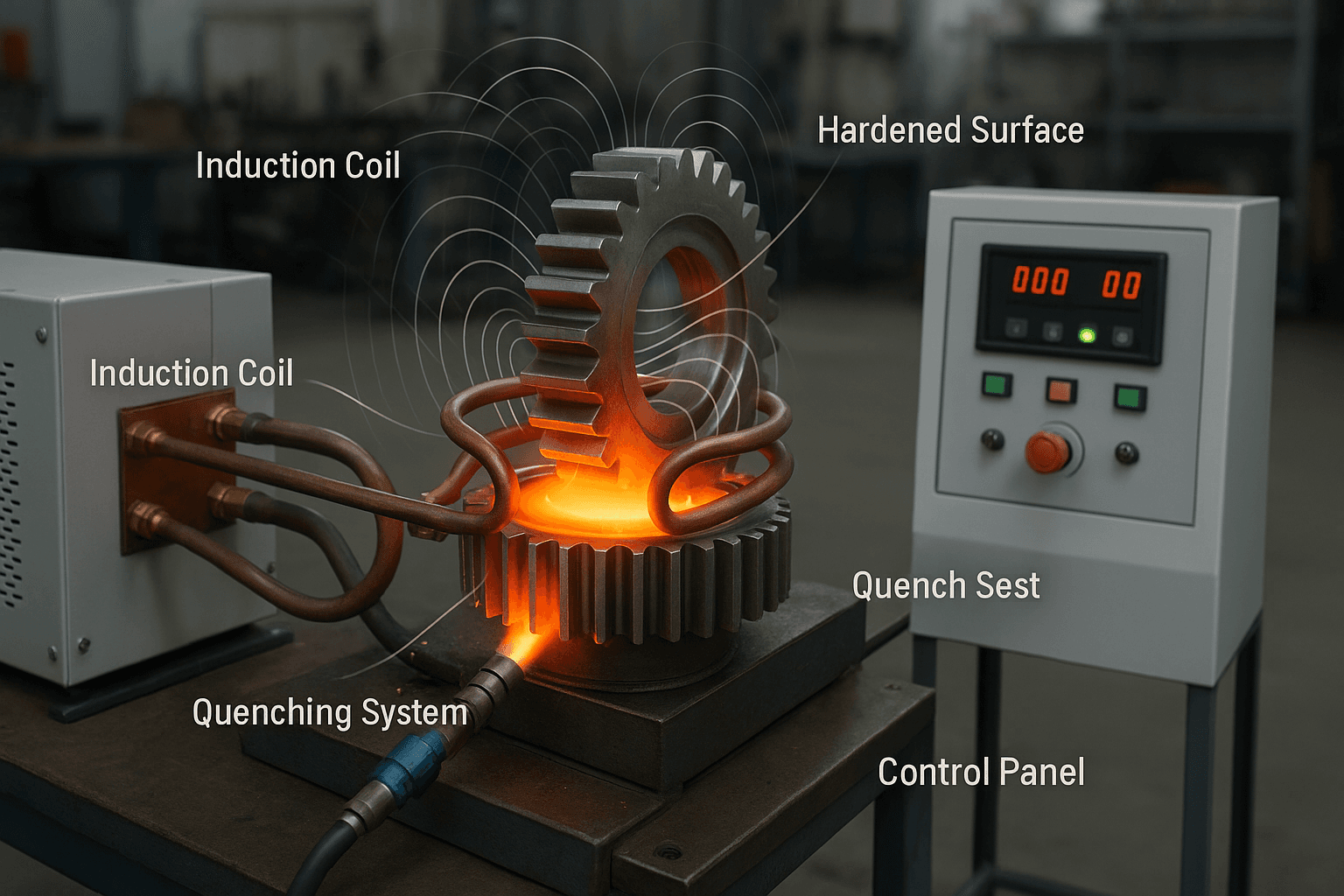
At Thakur Industries in Ludhiana, we run this exact induction hardening process every day on gears, shafts and crankshafts for automotive, agricultural and industrial customers across Punjab. This guide walks through each step of the process in order, explains the key parameters that control the result, and shows how we verify quality before a part leaves the floor.
The Induction Hardening Process in 5 Steps
Here is the complete induction hardening process from raw component to inspected part. Each step builds on the previous one, and the parameters at every stage are matched to the steel grade and the case depth the part needs.
- Component preparation — Inspect the part for material grade, machining accuracy and surface finish, then clean off oil, dust and contaminants so heat is absorbed uniformly.
- Induction heating — Place the component inside a shaped copper coil and pass high-frequency current through it. Eddy currents heat the surface to 850°C–950°C, forming austenite.
- Quenching — Cool the heated surface rapidly with a water or polymer spray. The austenite transforms into hard martensite, giving 50–60 HRC surface hardness.
- Tempering — Reheat lightly to 150°C–250°C to relieve internal stress, cut brittleness and improve toughness and fatigue resistance.
- Inspection and testing — Verify surface hardness (HRC), case depth and microstructure against the OEM or industrial specification before the part ships.
Step 1: Component preparation
Before hardening, every component is inspected for material composition, machining accuracy and surface finish. Any oil, dust or contaminants are removed so the part absorbs heat uniformly during heating. Typical materials include EN8, EN19 (4140), EN24 (4340), 20MnCr5 and other carbon and alloy steels. The steel needs enough carbon — roughly 0.30% or more — to form hard martensite when quenched. Curious what induction hardening is at a high level? Read our what is induction hardening primer.
Step 2: Induction Heating
The component is placed inside a copper induction coil precisely designed for its geometry. A high-frequency alternating current flows through the coil, creating a fluctuating magnetic field that induces eddy currents in the surface — heating it rapidly to 850°C–950°C. Three parameters control this step: the power frequency sets how deep the heat penetrates, the heating time sets the surface temperature, and the coil design ensures even heat distribution. The heated layer transforms into austenite, ready to be hardened.
The induction frequency is what controls how deeply the hardened case forms, so it is matched to the part being treated:
| Frequency Type | Depth of Hardening | Typical Application |
|---|---|---|
| Low (1–10 kHz) | Deep case (3–10 mm) | Shafts, axles, crankshafts |
| Medium (10–100 kHz) | Moderate case (1–5 mm) | Gears, rollers, pins |
| High (100–500 kHz) | Shallow case (<2 mm) | Small precision parts |
Step 3: Quenching
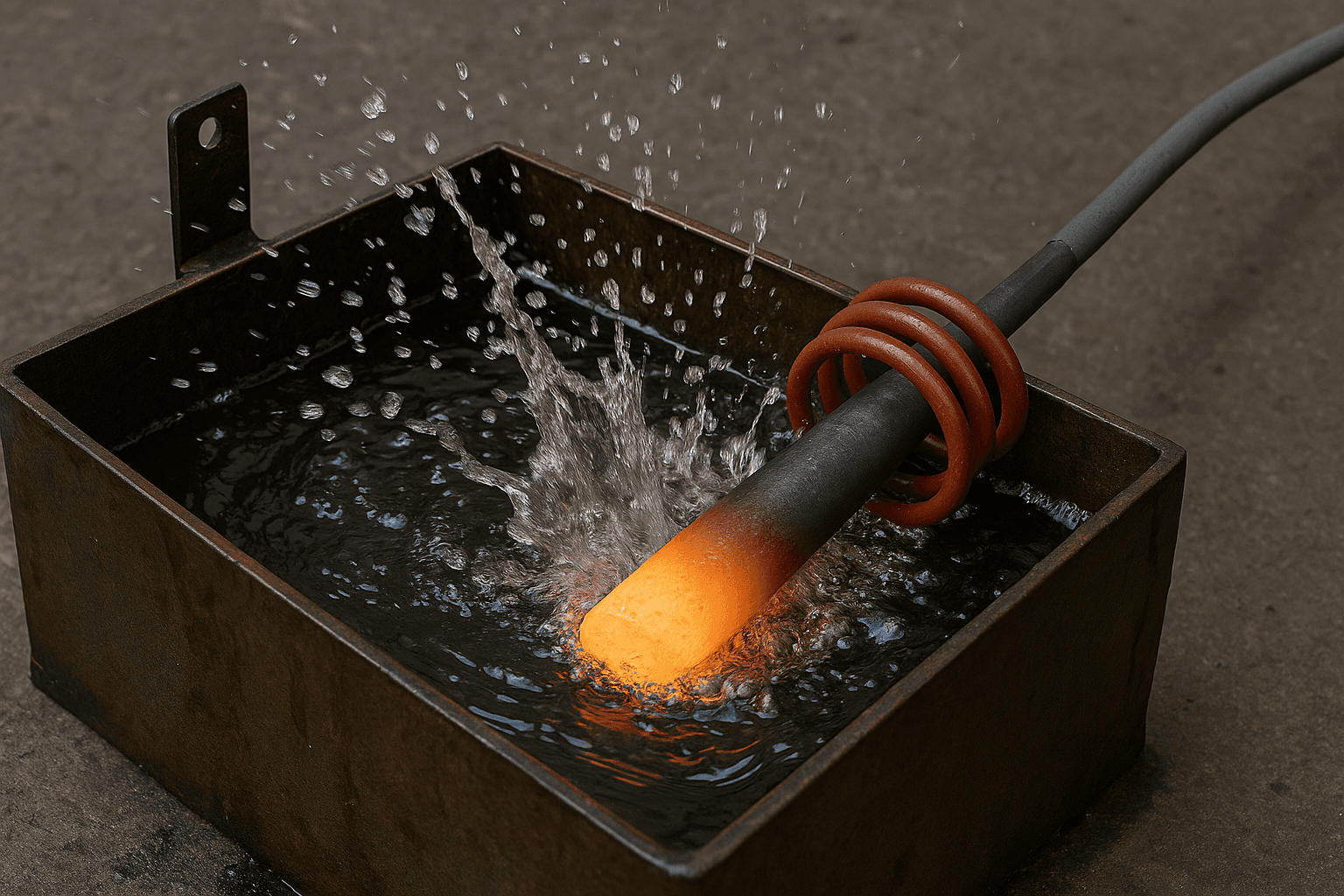
Immediately after heating, the surface is cooled rapidly with a water or polymer quench. Cooling is so fast that the heated austenitic layer transforms into martensite, giving extreme hardness — typically 50–60 HRC — with a wear-resistant case usually between 1.0 mm and 3.0 mm deep. Water quenching produces the deepest, hardest case for tough steels, while polymer quenching offers more controlled cooling with minimal distortion on precision parts.
Need professional induction hardening in Ludhiana? Get a quote
Send us your part drawings and we will recommend the right case depth and hardness for your steel grade — fast turnaround across Ludhiana and Punjab.
Step 4: Tempering
After quenching, the hardened component is reheated slightly to 150°C–250°C to relieve internal stresses created during rapid cooling. This light temper reduces brittleness and improves toughness and fatigue resistance — especially valuable for gears and shafts used in tractors and heavy-duty machinery. Tempering is optional but strongly recommended whenever a part will see repeated or shock loading. To understand why fast, controlled cooling matters so much, see our note on the role of quenching in induction hardening.
Step 5: Inspection & Testing
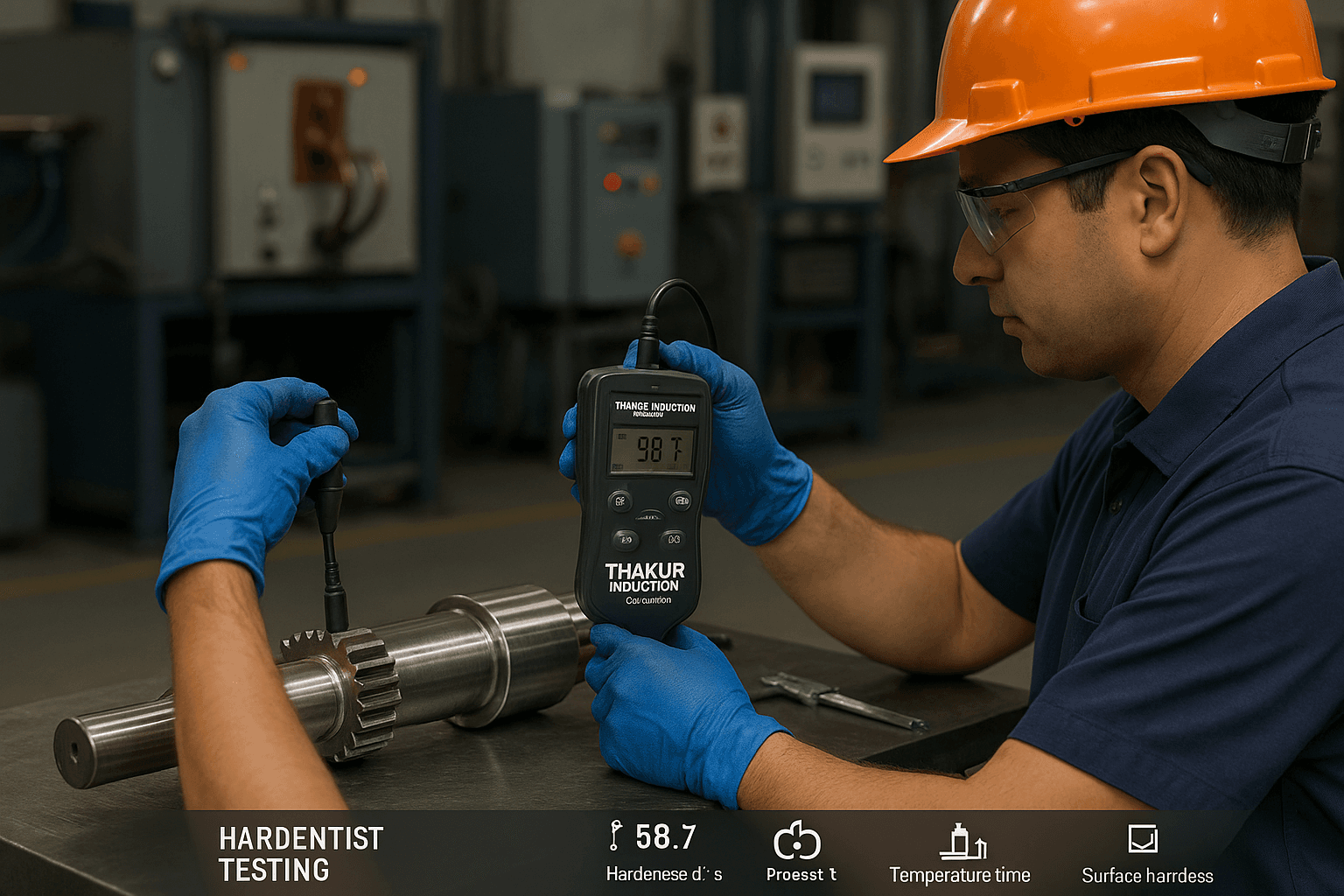
Once tempering is complete, every batch goes through quality control before delivery. We measure surface hardness in HRC, confirm the effective case depth, and examine the microstructure under magnification to verify a clean martensitic case. Each part is checked against the required OEM or industrial specification, so what leaves our floor in Ludhiana matches the drawing exactly.
For the underlying metallurgy and standards behind each step of the process, the ASM International heat treating resources are an authoritative reference.
Why This Process Wins for Gears, Shafts and Crankshafts
Because the induction hardening process is localized, fast and repeatable, it is the preferred route wherever a surface must resist wear while the core stays tough. We apply it to gear tooth flanks through our gear hardening service, to bearing journals and splines via our shaft hardening service, and to crankshaft fillets and journals that must survive bending and torsional loads. Explore the full capability on our induction heat treatment page, or request a quote for your components.
Frequently Asked Questions
What are the steps of the induction hardening process?
The induction hardening process has five steps: (1) component preparation and cleaning, (2) induction heating to austenitizing temperature, (3) rapid quenching to form martensite, (4) tempering to relieve stress, and (5) inspection and hardness testing.
What temperature is used for induction hardening?
The surface is heated to its austenitizing range, typically 850°C–950°C depending on the steel grade, then quenched. Tempering afterwards is done at a much lower 150°C–250°C.
Is tempering always required after induction hardening?
Tempering is optional but strongly recommended. A light temper at 150°C–250°C relieves quenching stresses and reduces brittleness, which is important for gears and shafts under heavy, repeated loads.
How is the induction hardening process quality-checked?
Each batch is checked for surface hardness in HRC, effective case depth, and microstructure under magnification, ensuring the part meets the required OEM or industrial standard before delivery.
Where can I get the induction hardening process done in Ludhiana, Punjab?
Thakur Industries runs the full induction hardening process — prep, heating, quenching, tempering and testing — for gears, shafts and crankshafts as job work across Ludhiana and Punjab.
Looking for Induction Hardening Job Work in Ludhiana, Punjab?
Partner with Thakur Industries — a trusted name for the complete induction hardening process: prep, heating, quenching, tempering and testing across Punjab.