What Is Induction Hardening?
Published June 2026•Updated June 2026
Induction hardening is a surface heat treatment process that uses electromagnetic induction to rapidly heat the outer layer of a steel component, then quenches it to create a hard, wear-resistant case. The tough inner core is left untouched, so the part resists wear on the surface yet stays strong and shock-resistant inside.
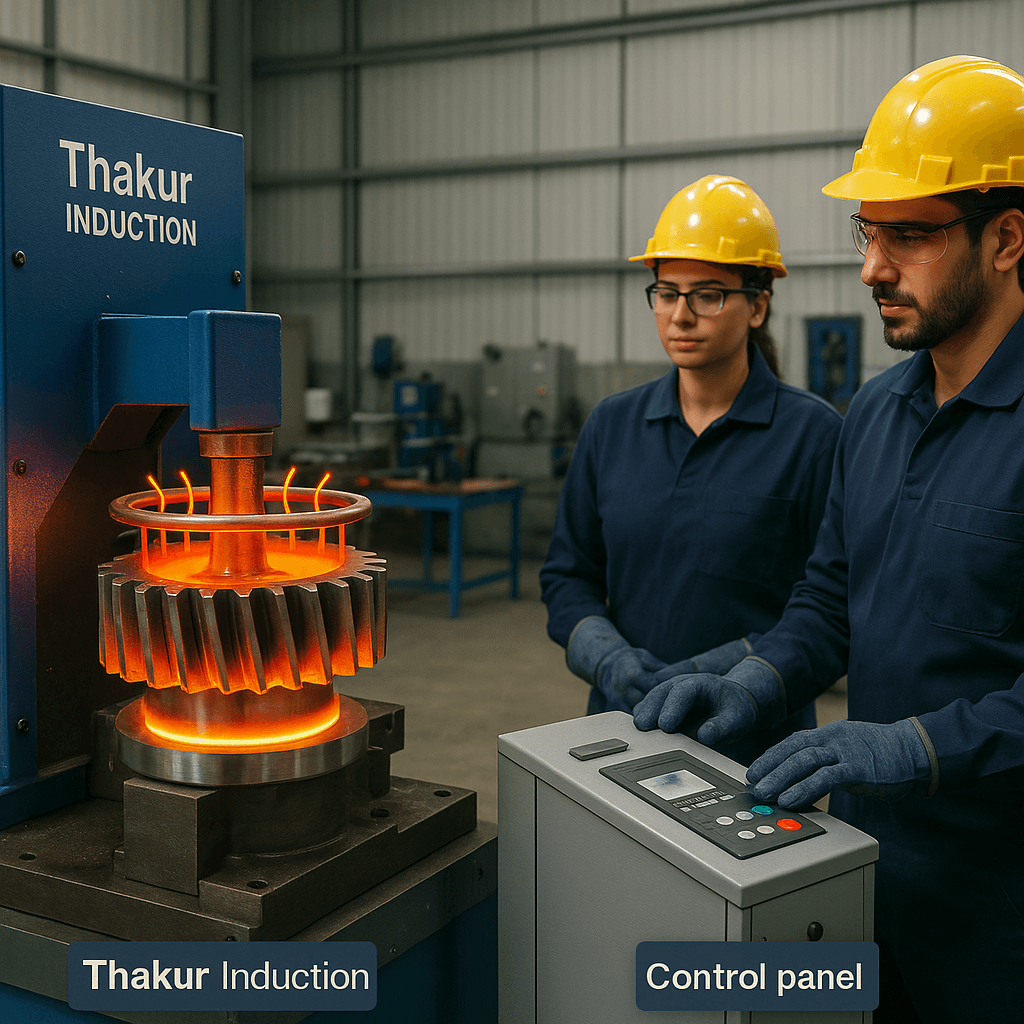
From gears and shafts to crankshafts and pins, manufacturers across Ludhiana and Punjab rely on induction hardening to boost durability, wear resistance and fatigue life without making the whole component brittle. Below we define exactly what induction hardening is, explain how the process works step by step, show where it is used, list its key benefits, and compare it with other hardening methods.
How Induction Hardening Works
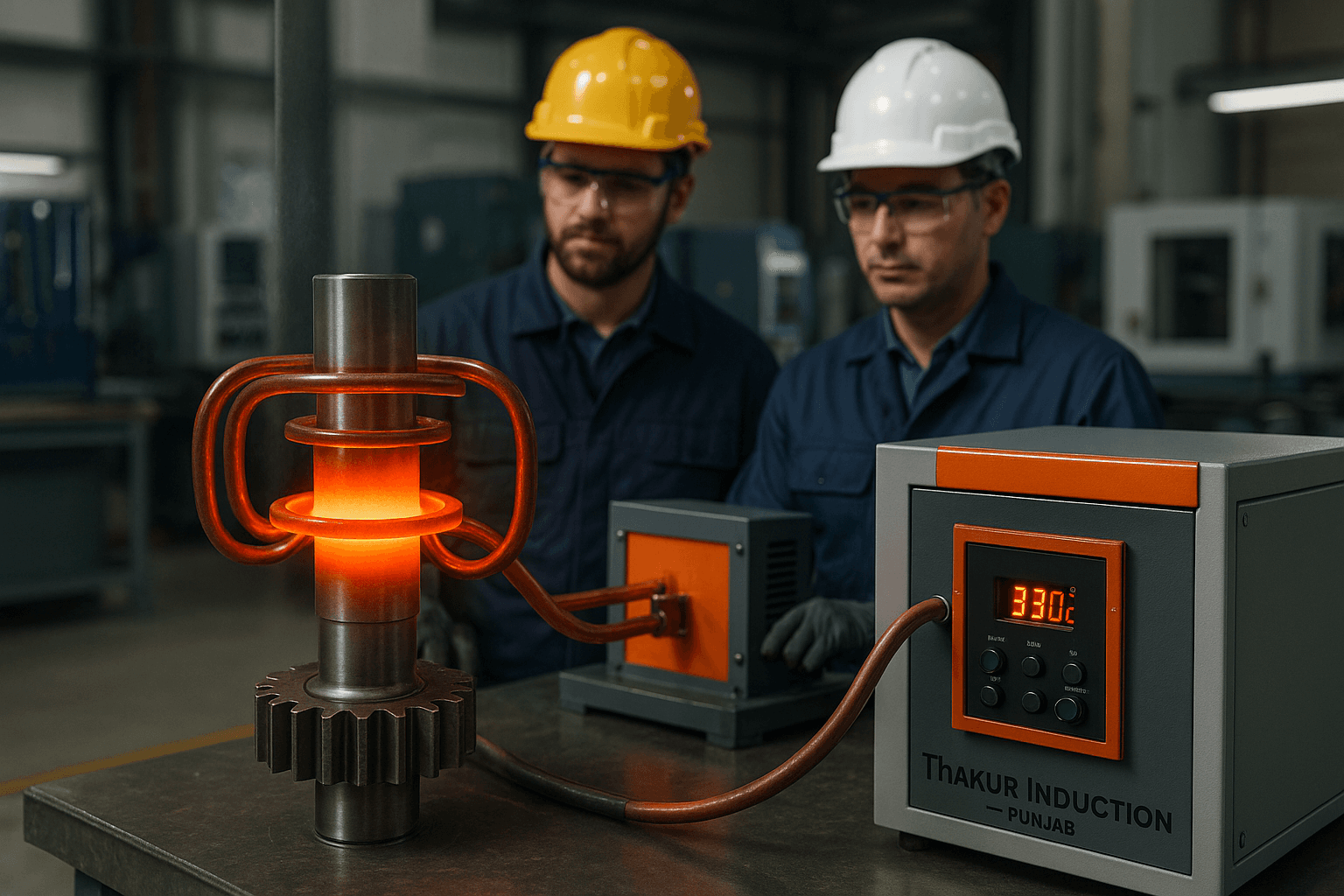
Induction hardening works by passing a high-frequency alternating current through a shaped copper coil placed around the component. The coil generates a fluctuating magnetic field that induces eddy currents in the steel surface, heating it to its austenitizing temperature (usually 850°C–950°C) within seconds. The heated layer is then quenched almost instantly. The process has three core stages:
1. Induction heating
The component sits inside a copper induction coil. As high-frequency current flows through the coil, eddy currents form on the part’s surface and heat it rapidly. The power frequency controls how deep the heat penetrates, the heating time sets the surface temperature, and the coil design ensures even heat distribution. At Thakur Industries in Ludhiana, medium- and high-frequency machines deliver precise, uniform heating for grades such as EN8, EN19, EN24 and 4340.
2. Quenching (rapid cooling)
The moment target temperature is reached, the surface is quenched with a water or polymer solution. Cooling is so fast that the austenitic structure transforms into hard martensite, producing surface hardness of roughly 50–60 HRC. Water quenching gives the deepest, hardest case for tough steels, while polymer quenching offers controlled cooling with minimal distortion for precision parts.
3. Tempering (optional but recommended)
A light reheat to roughly 150°C–250°C relieves internal stress, reduces brittleness and improves toughness and fatigue resistance. Tempering is especially valuable for gears and shafts that run under heavy, repeated loads.
Frequency selection and case depth
The induction frequency is what controls how deeply the hardened case forms, so it is matched to the part being treated.
| Frequency Type | Depth of Hardening | Typical Application |
|---|---|---|
| Low (1–10 kHz) | Deep case (3–10 mm) | Shafts, axles, crankshafts |
| Medium (10–100 kHz) | Moderate case (1–5 mm) | Gears, rollers, pins |
| High (100–500 kHz) | Shallow case (<2 mm) | Small precision parts |
By tuning frequency and heating duration, our specialists tailor the hardness depth and profile of each component. You can read the full workflow in our step-by-step induction hardening process guide.
Need induction hardening in Ludhiana? Get a fast quote
Send us your part drawings and we will recommend the right case depth and hardness for your steel grade — fast turnaround across Ludhiana and Punjab.
Where Induction Hardening Is Used (Gears, Shafts, Crankshafts)
Because the process is localized and repeatable, induction hardening is the go-to choice wherever a steel surface must resist wear, contact stress and fatigue while the core stays tough:
- Gears — tooth flanks are hardened for wear and pitting resistance. See our gear hardening service.
- Shafts and axles — bearing journals and splines are hardened against rubbing and fatigue. See our shaft hardening service.
- Crankshafts — fillets and journals are hardened to survive bending and torsional loads.
- Pins, rollers, cams and spindles — high-contact wear zones are selectively hardened.
- Agricultural and industrial parts — tractor spindles, PTO shafts and transmission gears.
Across Ludhiana, Khanna, Rajpura and Mandi Gobindgarh, induction hardening supports both OEM production and after-market job work. Explore the full range on our induction heat treatment page.
Key Benefits of Induction Hardening
The advantages of induction hardening make it ideal for precision manufacturing and high-volume runs:
- Localized hardening — only the functional surface is treated, minimizing distortion.
- Repeatable results — digital process controls deliver identical results batch after batch.
- Energy efficiency — fast heating uses less energy and lowers cost per component.
- Enhanced durability — hardened surfaces resist friction, wear and fatigue.
- Clean and eco-friendly — no open flames, fumes or toxic emissions.
- Tough core retained — the part absorbs shock loads without cracking.
For deeper background on the underlying metallurgy, the ASM International heat treating resources are an authoritative reference.
Induction vs Other Hardening Methods
Traditional flame or furnace methods heat the whole component, wasting energy and risking distortion. Induction hardening is fast, localized and highly controllable. Here is how the main methods compare:
| Method | Heat Source | Speed | Distortion | Best For |
|---|---|---|---|---|
| Induction hardening | Electromagnetic induction, localized | Seconds per part | Minimal | Gears, shafts, crankshafts, mass production |
| Flame hardening | Open oxy-gas flame | Slower, manual | Moderate | Large, low-volume parts |
| Carburizing (case hardening) | Furnace + carbon diffusion | Hours | Higher (full heating) | Low-carbon steels needing deep case |
| Through hardening | Full-body furnace heating | Hours | Highest | Parts needing uniform core hardness |
For a focused head-to-head, see our induction hardening vs flame hardening comparison. For businesses in Punjab needing minimal distortion and tight repeatability, induction is usually the preferred heat treatment route.
Frequently Asked Questions
What is induction hardening in simple terms?
Induction hardening is a surface heat treatment that uses electromagnetic induction to rapidly heat the outer layer of a steel component, followed by quenching. This creates a hard, wear-resistant surface while the core stays tough and ductile.
What materials can be induction hardened?
Medium-carbon and alloy steels respond best — common grades include EN8, EN19 (4140), EN24 (4340), 4150 and 20MnCr5. The steel needs enough carbon (typically 0.30% or more) to form hard martensite during quenching.
How hard does induction hardening make steel?
Surface hardness typically reaches 50–60 HRC depending on the steel grade and process settings, with case depths ranging from under 1 mm to around 10 mm controlled by the induction frequency.
How is induction hardening different from carburizing or flame hardening?
Carburizing adds carbon to low-carbon steel inside a furnace and is slow; flame hardening uses an open gas flame and is harder to control. Induction hardening is faster, cleaner, highly localized and far more repeatable.
Where can I get induction hardening done in Ludhiana, Punjab?
Thakur Industries provides induction hardening, gear hardening, shaft hardening and surface heat treatment job work across Ludhiana and Punjab, with hardness and case-depth testing on every batch.
Looking for Induction Hardening Job Work in Ludhiana, Punjab?
Partner with Thakur Industries — a trusted name in induction hardening, case hardening and surface heat treatment job work across Punjab.