Induction Hardening vs Flame Hardening: Which Is Better?
Induction hardening is better for most modern parts: it delivers ±0.1 mm precision, excellent repeatability and 85–90% energy efficiency with very low distortion. Flame hardening still wins on large, simple or one-off components where its lower tooling cost makes more sense.
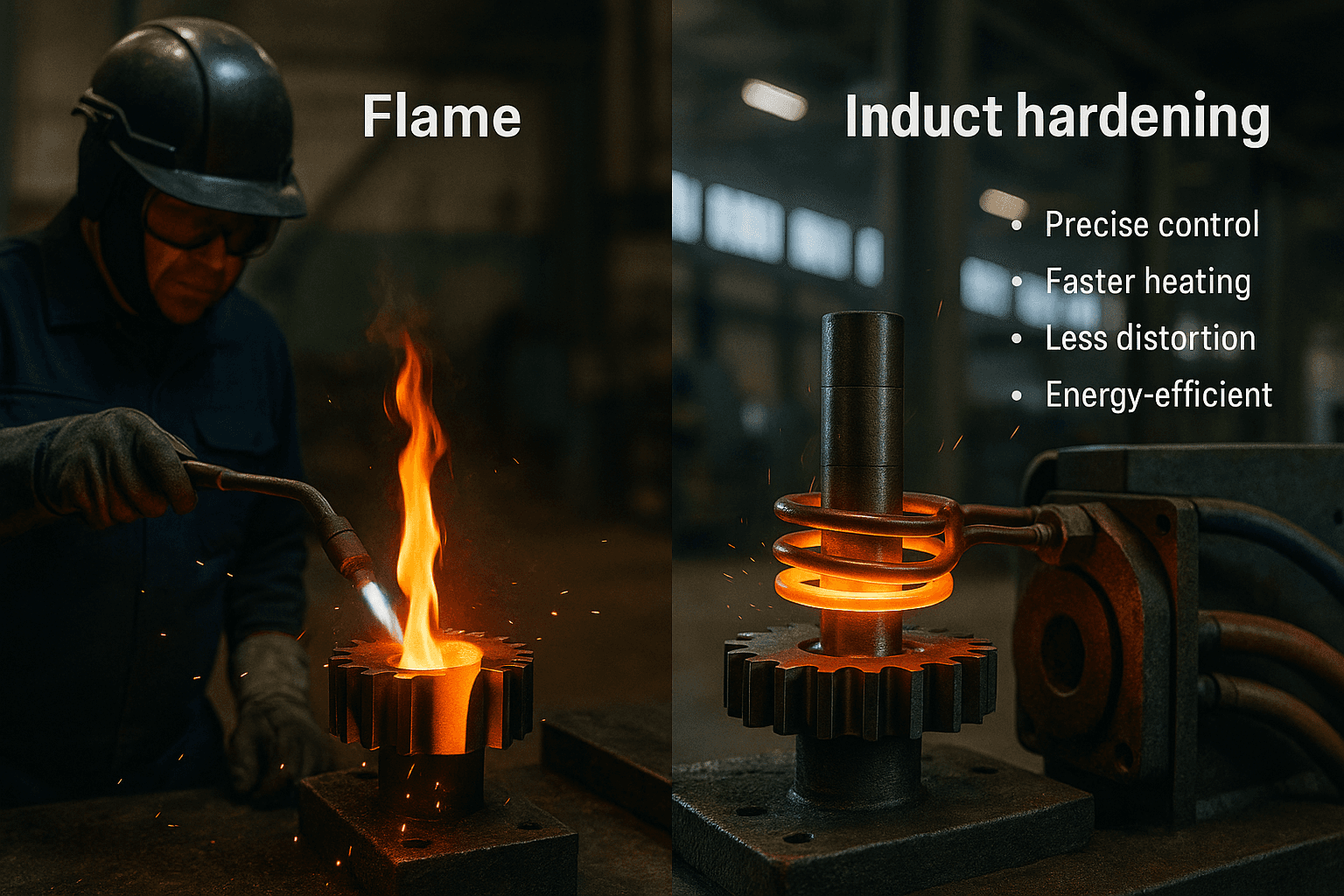
At Thakur Industries, Ludhiana, we run modern induction hardening lines for automotive, agricultural and industrial components across Punjab — and we are regularly asked how it compares with traditional flame hardening. Both are surface heat-treatment methods that create a hard, wear-resistant case over a tough core, but they differ sharply in control, speed and consistency. This guide breaks down the differences so you can choose the right process for your part.
Induction hardening delivers cleaner, faster and more accurate results; flame hardening keeps a niche for large or low-volume work.
Induction Hardening vs Flame Hardening: Comparison Table
The table below summarizes how the two processes compare on the factors that matter most when selecting a surface hardening method.
| Parameter | Induction Hardening | Flame Hardening |
|---|---|---|
| Heating Source | Contactless electromagnetic field | Direct oxy-fuel flame |
| Control & Precision | Precise (±0.1 mm), localized | Limited, broad heating |
| Repeatability | Excellent (digital control) | Inconsistent (operator-dependent) |
| Heating Speed | 2–10 seconds | 1–5 minutes |
| Part Size Suited | Small to medium production parts | Large, simple or one-off parts |
| Distortion Risk | Very low | Moderate to high |
| Energy Efficiency | 85–90% | 40–50% |
| Setup / Tooling Cost | Higher upfront (custom coils) | Lower upfront, higher per-part labour |
| Best For | Gears, shafts, axles, high-volume runs | Large rolls, dies, field repairs |
How Each Process Works
Flame hardening is a traditional surface heat-treatment process that uses oxy-acetylene or oxy-gas flames to heat a specific area of the metal surface. Once the surface reaches the desired temperature (usually between 850°C and 950°C), it is rapidly quenched using water or oil. Because the flame is applied manually, the heated zone and case depth depend heavily on operator skill.
Induction hardening uses electromagnetic induction to heat metal surfaces without direct contact. A coil generates alternating magnetic fields, inducing heat only in the desired area. The surface is then quenched using water or polymer, producing a hard martensitic layer while keeping the inner core tough. The whole cycle is digitally controlled, so frequency, power and time are repeated exactly on every part. Learn the full sequence in our step-by-step induction hardening process guide.
Precision & Repeatability
Precision and repeatability are where induction hardening pulls clearly ahead, and they are the main reasons manufacturers move away from flame hardening for production work.
- Superior precision: Induction hardening provides targeted heating only to the critical wear zones (around ±0.1 mm), maintaining dimensional accuracy.
- High energy efficiency: Induction systems convert up to 90% of input energy into usable heat, compared with 40–50% in flame systems.
- Shorter cycle time: Parts can be hardened in seconds, not minutes, improving throughput and reducing cost per component.
- Automated & repeatable: Computer-controlled parameters ensure every part receives identical heat treatment — flame results vary with the operator.
- Reduced distortion: Localized heating minimizes warping — a major drawback of flame hardening.
- Cleaner & safer: No open flames, fumes or combustion gases, making it environmentally friendly and operator-safe.
Need precision induction hardening in Ludhiana?
Send us your part drawing and target hardness — we will recommend the right process and quote your job work.
Best Applications for Each
Neither process is universally superior — the right choice depends on part geometry, volume and size.
Choose induction hardening for production volumes and parts that demand consistent case depth: it excels on gears and pinions, shafts and axles, crankshafts and bearing races. Custom coils let it precisely heat complex profiles while keeping the core tough.
Choose flame hardening when components are very large or simple — big rolls, dies, machine ways and slideways — or for one-off and on-site repair work, where building a dedicated induction coil is uneconomical. For these jobs, flame hardening’s lower tooling cost outweighs its lower precision.
Case Study: Automotive Shaft Hardening
A Punjab automotive supplier asked us to benchmark flame hardening against induction hardening on the same transmission shaft. The results below show why they switched.
| Aspect | Flame Hardening | Induction Hardening |
|---|---|---|
| Cycle Time | 6 minutes | 30 seconds |
| Surface Hardness | 50–54 HRC | 58–60 HRC |
| Distortion | Moderate | Minimal |
| Repeatability | Inconsistent | Excellent |
| Energy Consumption | High | 40% Lower |
Result: After switching to induction hardening, the client reported a 25% increase in part life and a 30% reduction in energy use. Both processes target the surface hardness ranges set out by the ASM International heat-treating standards, but induction reached the higher, more consistent figures.
The Verdict
In the debate of induction hardening vs flame hardening, the verdict for modern production is clear: induction hardening offers unmatched precision, speed, repeatability and energy efficiency. Flame hardening retains a useful niche for large, simple or one-off parts. At Thakur Industries, Ludhiana, we combine advanced machinery and metallurgical expertise to deliver superior heat-treatment job work trusted by manufacturers across Punjab and North India. Compare it with related routes in our induction hardening process explainer, or request a quote on our induction hardening rate & quote page.
Frequently Asked Questions
Is induction hardening better than flame hardening?
For most modern automotive and industrial parts, yes. Induction hardening offers far tighter precision (±0.1 mm control), excellent repeatability, lower distortion and higher energy efficiency. Flame hardening still suits very large, simple, or one-off parts where the cost of induction tooling is not justified.
What is the main difference between induction and flame hardening?
The heat source. Induction hardening heats the surface with a contactless electromagnetic field, while flame hardening uses a direct oxy-fuel flame. That single difference drives induction’s faster heating, finer control and better repeatability.
Which process gives higher hardness?
In our automotive shaft trials, induction hardening reached 58–60 HRC versus 50–54 HRC for flame hardening, with a controllable case depth and a much lower distortion risk.
When is flame hardening still the right choice?
Flame hardening remains practical for very large components, simple geometries, on-site repairs and low-volume jobs where building an induction coil is uneconomical. For repeatable production runs, induction hardening is usually superior.
Do you offer induction hardening in Ludhiana, Punjab?
Yes. Thakur Industries provides precision induction hardening job work for gears, shafts, axles and crankshafts across Ludhiana, Punjab and North India, with digital process control and full hardness and case-depth testing.
Upgrade Your Heat Treatment Process Today
Get in touch with Thakur Industries, Ludhiana’s trusted name in industrial induction hardening and heat treatment job work.