Hardness Testing After Induction Hardening
Hardness testing after induction hardening is the final check that proves a part met spec. We measure surface hardness in HRC with a Rockwell tester, confirm effective case depth by Vickers microhardness traverse and record uniformity, then issue a certified test report for every batch from our Ludhiana, Punjab facility.
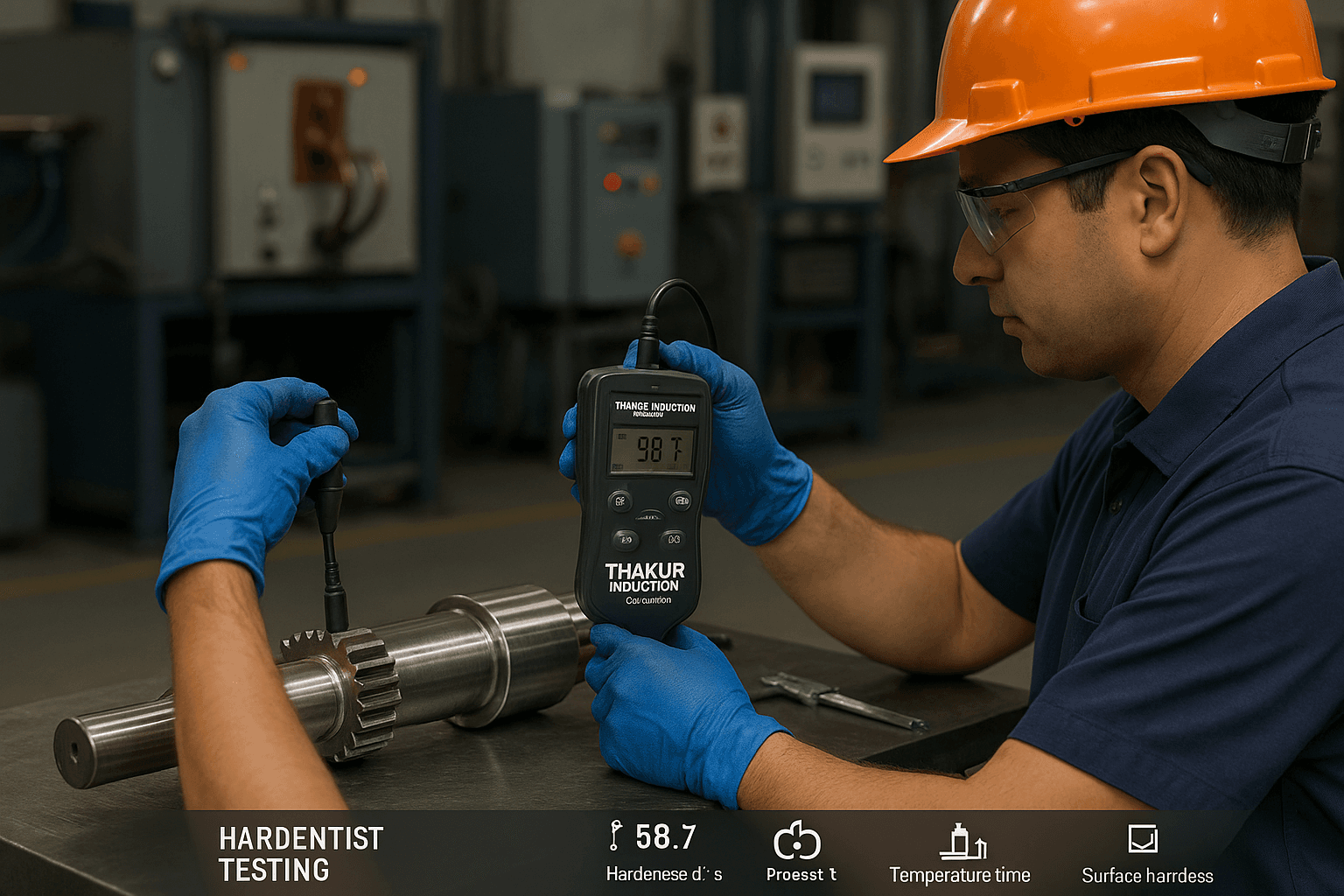
Why Test Hardness After Induction Hardening
Achieving the right surface hardness and case depth in induction hardening is never guesswork — it is a science built on measurement. Hardness testing measures a material’s resistance to deformation using a controlled indenter. After induction hardening, that reading tells us how effectively the surface transformed from softer ferrite or pearlite into hard martensite.
Verifying hardness after the process:
- Confirms that the heating and quenching cycle worked correctly
- Verifies that case depth and surface hardness meet the drawing specification
- Catches soft spots, over-hardening or shallow case before parts ship
- Ensures the component withstands wear, load and fatigue in real service
Hardness Test Methods at a Glance
Three methods cover almost every hardened part we deliver:
- Rockwell hardness (HRC) — fast surface readings for finished components.
- Vickers microhardness — precise measurement on small or thin zones.
- Case-depth traverse — a hardness profile from surface to core.
| Method | What it measures | Scale | Best for |
|---|---|---|---|
| Rockwell Hardness (HRC) | Surface hardness of finished parts | HRC / HRB | Fast batch inspection of hardened steel |
| Vickers Microhardness | Precise hardness on small or thin zones | HV | Lab verification, OEM and export parts |
| Case-Depth Traverse | Thickness of the hardened layer | HV (light loads) | Confirming effective case depth |
Rockwell HRC Method
The Rockwell test is the workhorse of hardness testing after induction hardening and the most common method in Punjab industry. A diamond cone indenter is pressed into the surface under a fixed load, and the depth of penetration is converted directly into a hardness number.
Scales used: the C scale (HRC) for hardened steels, typically reading 50–62 HRC, and the B scale (HRB) for softer cores.
Why we use it: it is fast, repeatable and non-destructive, making it ideal for inspecting whole production batches. We take multiple readings across each part to confirm hardness uniformity rather than relying on a single spot.
Steels such as EN19 and EN24 respond predictably here — see our EN19 and EN24 hardening guide for typical target values by grade.
Case-Depth Verification
Surface hardness alone does not guarantee performance — the hardened layer must also be deep enough to carry load. Case depth is verified with a Vickers microhardness traverse: a sample is sectioned, mounted and polished, then a row of tiny indentations is made from the surface inward.
Effective case depth is the distance from the surface to the point where hardness falls to a defined limit (commonly 513 HV, roughly 50 HRC). Microhardness gives a complete metallurgical profile — a must for OEM and export-grade work. For how we dial in that depth during the process itself, see case-depth control in induction hardening.
Our QC Process & Test Reports
Every hardened batch passes through a fixed set of quality-control checks before it is released:
| Parameter | Purpose | Method Used |
|---|---|---|
| Surface Hardness | To verify strength and wear resistance | Rockwell HRC |
| Case Depth | To ensure a sufficient hardened zone | Microhardness profiling |
| Core Hardness | To confirm ductility and support | Rockwell HRB |
| Hardness Uniformity | To detect over- or under-heating | Multi-point testing |
| Heat-Affected Zone | To check metallurgical structure | Microstructural analysis |
Worked example: for an automotive gear shaft in EN19 we recorded a surface hardness of 57 HRC, a case depth of 2.05 mm and uniformity within ±0.05 mm — passing export-quality inspection with 100% acceptance.
What a verified report delivers to you:
- Consistent quality: uniformity confirmed across large production batches.
- Failure prevention: soft spots, over-hardening and shallow case caught early.
- Compliance: readings matched to customer specs and recognised standards.
- Traceability: each test record links to a specific job or batch number.
- Client confidence: OEMs and exporters rely on data-backed proof of performance.
Our testing follows methods aligned with widely used metallurgical references such as the ASM International heat-treatment standards. See our quality certifications for the full inspection scope, and how this fits hardened gears and shafts.
Need hardened parts with HRC test reports in Ludhiana?
Get a quote with certified hardness and case-depth reports backing every batch.
Frequently Asked Questions
Why is hardness testing done after induction hardening?
Hardness testing after induction hardening confirms that heating and quenching actually produced a hard martensitic case. It verifies surface hardness in HRC, checks effective case depth and detects soft spots before parts leave the shop.
What HRC value should an induction-hardened part reach?
Most induction-hardened alloy steels such as EN19 and EN24 reach 55–62 HRC on the surface. The exact target depends on the steel grade and the drawing specification supplied by the customer.
How is case depth measured after induction hardening?
Case depth is measured with a Vickers microhardness traverse on a sectioned and polished sample. Indentations are made from the surface inward, and effective case depth is read at the point the hardness drops to a defined limit, typically 513 HV (around 50 HRC).
Do you provide a hardness test report with every job?
Yes. Every hardened batch from our Ludhiana facility ships with a test report listing surface hardness in HRC, measured case depth, uniformity readings and the linked job or batch number for full traceability.
Conclusion: Hardness Verified, Quality Certified
At Thakur Industries, disciplined hardness testing after induction hardening lets industries across Punjab, Haryana and Delhi NCR build products that last longer, perform better and meet international benchmarks. Surface hardness in HRC, effective case depth and uniformity are all measured, recorded and certified before a single part ships.
Need verified hardness testing?
Partner with Thakur Industries for tested, certified surface-hardening solutions in Ludhiana, Punjab.