EN19 vs EN24 Steel: Properties, Composition & Hardening
By the Thakur Industries Metallurgy Team · Reviewed by a Senior Heat-Treatment Engineer · Published November 2025 · Updated June 2026
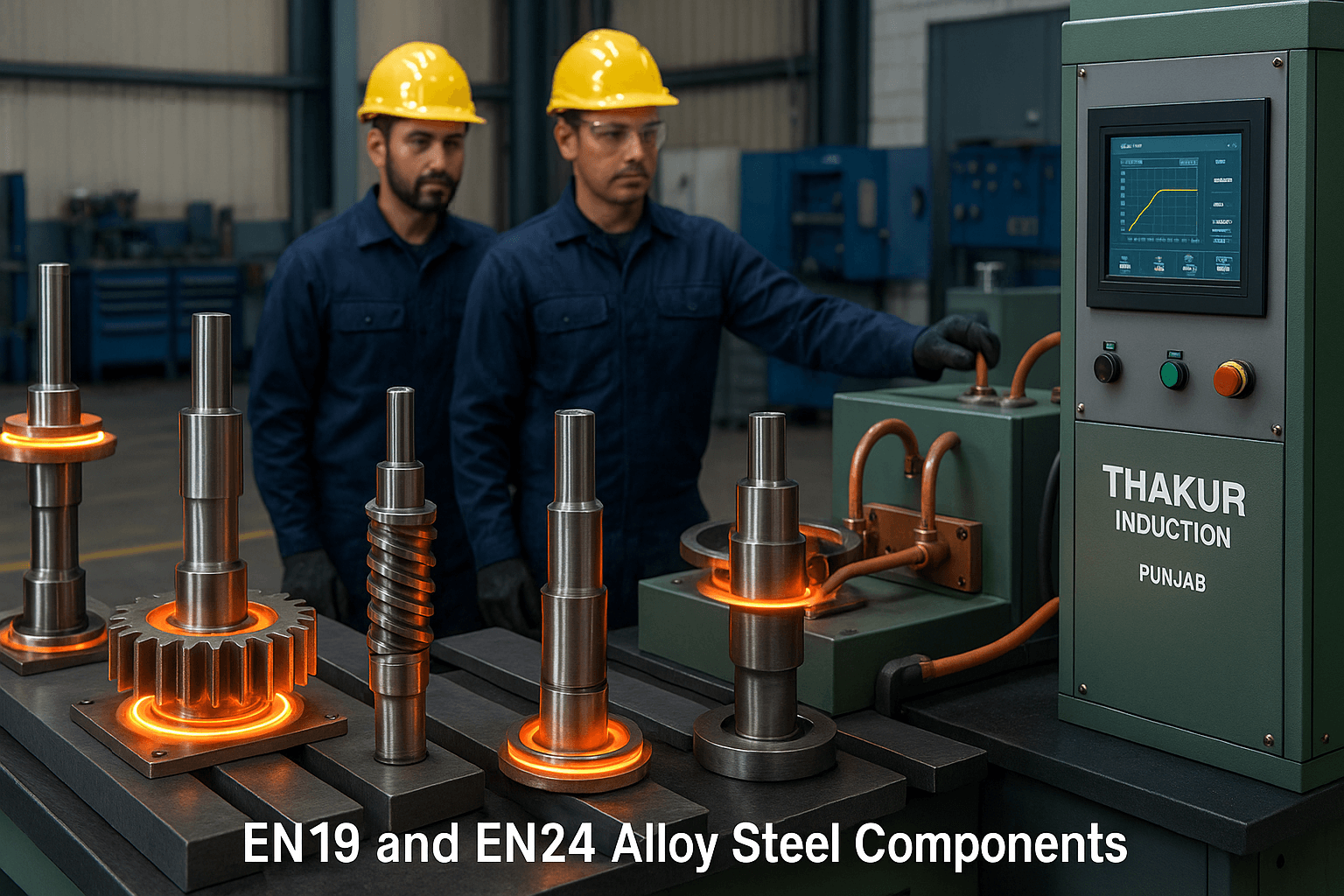
EN19 and EN24 are both chromium-molybdenum alloy steels with around 0.40% carbon, but the key difference is nickel: EN24 (817M40) adds 1.3–1.7% nickel for higher tensile strength, deeper hardenability and superior toughness, while nickel-free EN19 (709M40) is the more economical grade for medium-load parts.
On this page
EN19 vs EN24 Composition & Properties Comparison
EN19 and EN24 are workhorse engineering steels specified across automotive, agricultural and heavy-equipment manufacturing. Both are low-alloy steels hardened and tempered to develop their full mechanical properties, and both respond extremely well to induction hardening. The single most important variable separating their properties is nickel content, which controls hardenability and toughness in thick sections.
EN19 is the British Standard designation for grade 709M40, equivalent to AISI 4140. EN24 is grade 817M40, equivalent to AISI 4340. The comparison table below summarises the core EN19 vs EN24 steel properties side by side.
| Property | EN19 (709M40 / AISI 4140) | EN24 (817M40 / AISI 4340) |
|---|---|---|
| Carbon (C %) | 0.35–0.45 | 0.36–0.44 |
| Chromium (Cr %) | 0.9–1.2 | 1.0–1.4 |
| Nickel (Ni %) | — | 1.3–1.7 |
| Molybdenum (Mo %) | 0.2–0.4 | 0.2–0.4 |
| Manganese (Mn %) | 0.5–0.8 | 0.45–0.7 |
| Tensile strength | 700–850 MPa | 850–1100 MPa (up to ~1550) |
| Achievable hardness | 55–58 HRC | 57–60 HRC |
| BS 970 / AISI equivalent | 709M40 / 4140 | 817M40 / 4340 |
| Typical uses | Gears, spindles, pins, bolts | Crankshafts, heavy axles, aero shafts |
As the table shows, the two grades share an almost identical carbon and molybdenum range. EN24 carries a modestly higher chromium band and, critically, the nickel addition that EN19 lacks entirely. That nickel is why EN24 commands a higher price and why it is reserved for the most demanding components. For a deeper look at the chromium-molybdenum family, our 4140 steel hardening guide covers the AISI 4140 (EN19 equivalent) in detail.
Mechanical Properties: EN19 vs EN24
In the heat-treated condition both steels are strong, but EN24 holds its strength through larger cross-sections thanks to its nickel content. EN19 typically develops a tensile strength of 700–850 MPa, while EN24 reaches 850–1100 MPa and, in high-strength tempers, can be pushed toward 1550 MPa. EN24 also delivers measurably better impact toughness and fatigue endurance, which is decisive for rotating and cyclically loaded parts.
| Mechanical property | EN19 (709M40) | EN24 (817M40) |
|---|---|---|
| Hardenability | Good (medium sections) | Excellent (large sections) |
| Toughness / impact | Good | Superior (nickel-aided) |
| Fatigue strength | High | Very high |
| Machinability (annealed) | Better | Slightly lower |
| Relative cost | Lower | Higher |
EN19 is generally easier to machine in the annealed state and is the more cost-effective option where the extra toughness of EN24 is not required. EN24, by contrast, justifies its premium in safety-critical, heavy-section components where fatigue failure is unacceptable. These property differences are well documented in metallurgical references such as the ASM International handbooks on low-alloy steels.
Which Hardens Better — EN19 or EN24?
This is the question most engineers actually want answered, and the result is often misunderstood. Peak surface hardness after induction hardening is governed almost entirely by carbon content, and because both EN19 and EN24 hold roughly 0.40% carbon, both reach a similar martensitic surface hardness — EN19 around 55–58 HRC and EN24 around 57–60 HRC.
The real differentiator is hardenability, not peak hardness. Nickel and the higher chromium in EN24 shift its hardenability so that a hard martensitic structure forms deeper and more uniformly in large diameters, with less risk of soft cores. For a thin or medium part the two grades behave almost identically; for a thick crankshaft or heavy axle, EN24 hardens more consistently through section.
| Steel Grade | Surface Hardness (HRC) | Typical Case Depth (mm) | Quenching Medium |
|---|---|---|---|
| EN19 (709M40 / 4140) | 55–58 | 2.0–3.0 | Polymer (10%) |
| EN24 (817M40 / 4340) | 57–60 | 2.5–4.0 | Water or polymer (8%) |
At Thakur Industries, every EN19 and EN24 component is processed on medium-frequency induction systems (10–50 kHz) and undergoes 100% hardness, case-depth and microstructure inspection before delivery.
For grade-specific process parameters and job-work details, see our dedicated EN19 steel induction hardening and EN24 steel hardening service pages.
Need EN19 or EN24 hardening in Ludhiana? Get a quote
Thakur Industries delivers precision induction hardening for EN19 (709M40 / 4140) and EN24 (817M40 / 4340) components across Ludhiana, Punjab and North India — with full inspection reports.
Applications: Choosing EN19 vs EN24
The selection logic in practice is straightforward. Use EN19 for medium-load, cost-sensitive parts in lighter sections, and step up to EN24 for high-load, fatigue-critical or large-diameter components where through-section toughness is essential.
| Industry | Typical EN19 & EN24 Applications |
|---|---|
| Automotive | EN24 crankshafts & drive shafts; EN19 transmission pins, gear hubs |
| Agriculture | EN19 tractor spindles & PTO shafts; EN24 heavy axles |
| Heavy Machinery | EN24 rollers & large couplings; EN19 medium pins |
| Forging & Tooling | EN24 mandrels & high-load dies; EN19 general tooling |
Whichever grade your drawing specifies, the heat-treatment route is similar: clean the part, induction-heat the surface to 850–950°C, quench to martensite, optionally temper at 150–250°C to relieve stress, then verify hardness and case depth. Ready to move forward? Request a tailored quote through our get a quote page.
Frequently Asked Questions
What is the main difference between EN19 and EN24 steel?
The defining difference is nickel content. EN24 (817M40 / AISI 4340) contains 1.3–1.7% nickel, giving it greater hardenability, toughness and fatigue strength in large sections. EN19 (709M40 / AISI 4140) has effectively no nickel, making it a more economical chromium-molybdenum grade for medium-stress parts.
Which is stronger, EN19 or EN24?
In the hardened-and-tempered condition EN24 reaches a higher tensile strength (typically 850–1100 MPa, up to ~1550 MPa) and retains strength through thicker sections than EN19 (typically 700–850 MPa). For thin or moderately loaded parts the practical difference is small and EN19 is often the cost-effective choice.
Does EN19 or EN24 reach a higher hardness after induction hardening?
Both reach a similar surface hardness because surface hardness is governed by carbon content, and both grades hold ~0.40% carbon. EN24 typically achieves 57–60 HRC and EN19 55–58 HRC. The real advantage of EN24 is deeper, more uniform hardenability in large cross-sections, not a higher peak HRC.
What are the equivalent grades for EN19 and EN24?
EN19 corresponds to BS 970 709M40 and AISI 4140. EN24 corresponds to BS 970 817M40 and AISI 4340. These equivalents are widely cross-referenced in OEM and export specifications.
When should I choose EN19 over EN24?
Choose EN19 for medium-load, cost-sensitive components such as gears, spindles and pins in light-to-medium sections. Choose EN24 for high-load, fatigue-critical or large-diameter parts like crankshafts, heavy axles and aerospace-grade shafts where through-hardenability and toughness matter most.
Conclusion: Matching the Grade to the Job
EN19 and EN24 are close cousins in the chromium-molybdenum family, but the nickel in EN24 (817M40 / 4340) buys higher tensile strength, deeper hardenability and superior toughness — at a higher cost. EN19 (709M40 / 4140) remains the smart, economical choice for medium-load parts. Both achieve excellent induction-hardened surfaces of 55–60 HRC. At Thakur Industries, Ludhiana, our metallurgy team helps manufacturers select and harden the right grade with repeatable, fully inspected results for automotive, agricultural and export-oriented industries.