Induction Hardening vs Nitriding: Differences & Uses
A clear, metallurgy-backed comparison of induction hardening and nitriding — covering temperature, case depth, distortion, hardness and which process suits your steel parts.
By the Thakur Industries Metallurgy Team · Reviewed by the Heat-Treatment Process Engineering Team
Published 18 February 2026 · Updated 13 June 2026
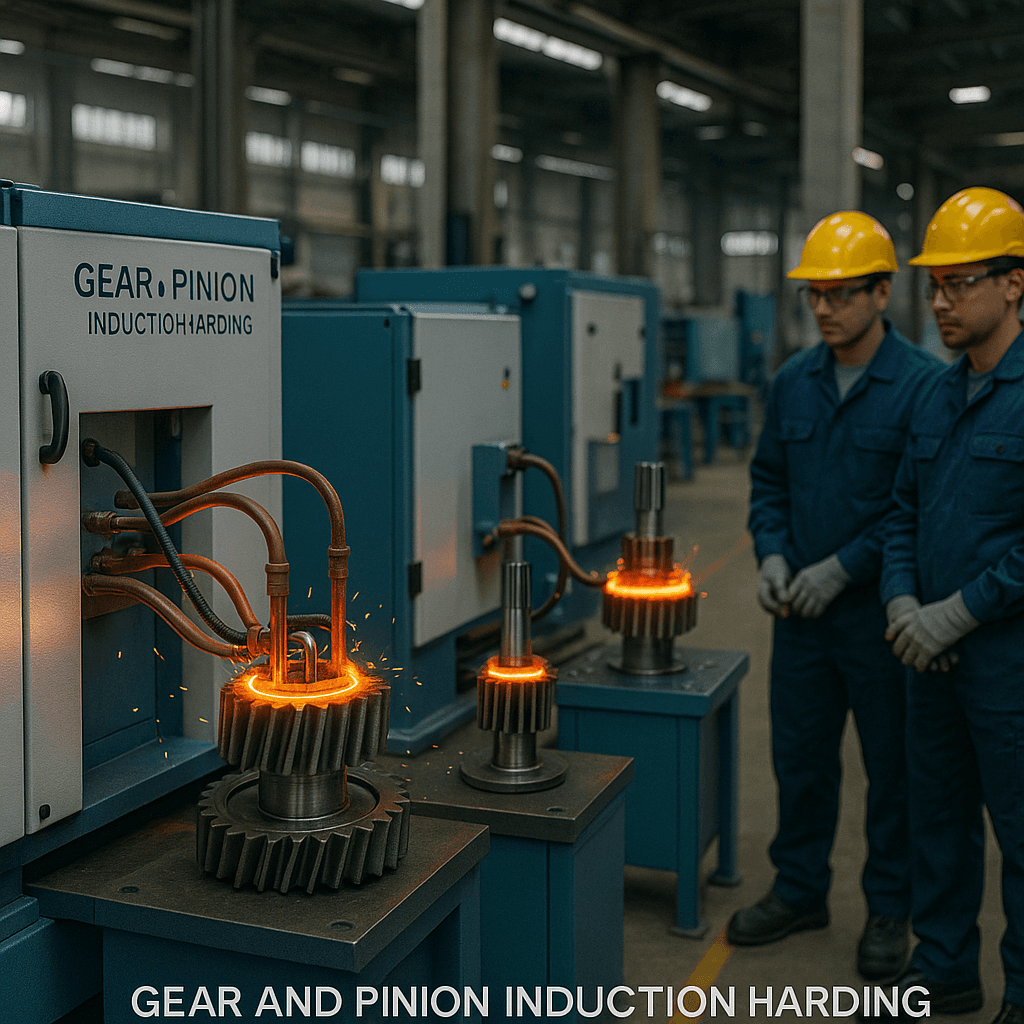
The core difference: induction hardening heats steel above 850°C and quenches it to form a deep, martensitic case (0.5–5 mm) in seconds, ideal for load-bearing gears and shafts. Nitriding diffuses nitrogen at 500–550°C with no quench, building a very thin (0.1–0.7 mm) but extremely hard, low-distortion layer best for tools and dies.
Comparison Table: Induction Hardening vs Nitriding
Both are surface-hardening processes used heavily across Punjab's automotive, tractor and machinery industries, but they harden steel in fundamentally different ways. The table below summarises the key differences at a glance.
| Parameter | Induction Hardening | Nitriding |
|---|---|---|
| Process Temperature | 850–950°C | 500–550°C |
| Case Depth | 0.5–5 mm | 0.1–0.7 mm |
| Distortion | Low (localized heating + quench) | Very low (no quench) |
| Surface Hardness | 50–62 HRC | 55–70 HRC (thin layer) |
| Materials | Carbon & alloy steels (EN8, EN19, EN24, 4140) | Nitriding steels (EN41B, Nitralloy, H13) |
| Processing Time | Seconds to minutes | 10–40 hours |
| Best For | Gears, shafts, axles, crankshafts | Dies, molds, spindles, valves |
In short: induction hardening wins on speed, depth and cost; nitriding wins on corrosion resistance and the lowest possible distortion. Learn more about the process itself in our induction hardening process guide, or see the full induction heat treatment service.
How Nitriding Differs From Induction Hardening
Induction hardening is a transformation process: electromagnetic induction heats the surface to 850–950°C to form austenite, then rapid water or polymer quenching converts it into hard martensite. The core stays tough and ductile. It works on standard carbon and alloy steels such as EN8, EN19 and EN24.
Nitriding is a diffusion process: nitrogen is introduced into the steel surface at a much lower 500–550°C in a gas or plasma atmosphere, forming hard iron-nitride compounds (Fe₄N, Fe₂–₃N). Because there is no phase transformation and no quench, parts barely move dimensionally — but the process requires special nitriding-grade alloys and runs for many hours.
Mechanism, in brief
- Induction hardening: martensitic transformation by rapid heating and quenching.
- Nitriding: surface nitride formation by nitrogen diffusion — no quench needed.
Hardness & Case Depth
This is where the two processes diverge most. Nitriding produces a slightly higher peak surface hardness (55–70 HRC) but only in a paper-thin 0.1–0.7 mm layer. Induction hardening reaches 50–62 HRC across a much deeper 0.5–5 mm case, which is what load-bearing components actually need to resist bending, torsion and contact fatigue.
- Need a deep, fatigue-resistant case on a shaft or gear → induction hardening.
- Need a very hard, thin wear/corrosion skin on a die or spindle → nitriding.
Performance & Cost at a Glance
| Factor | Induction Hardening | Nitriding |
|---|---|---|
| Processing Speed | ||
| Depth of Hardness | ||
| Corrosion Resistance | ||
| Fatigue Strength | ||
| Dimensional Stability | ||
| Cost (per part) |
For automotive and heavy-duty parts, induction hardening is usually preferred for its speed, cost-efficiency and deeper hardness. Case-depth and hardness targets are verified per the standards summarised by ASM International.
Need EN19/EN24 induction hardening in Punjab? Get a quote
Thakur Industries, Ludhiana delivers controlled-case-depth induction hardening for EN19, EN24 and 4140 gears, shafts and transmission parts — fast turnaround for OEMs across Punjab, Haryana and Delhi NCR.
Which to Choose for Your Part
The right process depends on the load, geometry and steel grade. Use this material guide as a starting point.
| Steel Grade | Suitable Process | Typical Use |
|---|---|---|
| EN8 / C45 | Induction Hardening | Shafts, axles |
| EN19 / 4140 | Induction Hardening | Gears, spindles |
| EN24 / 4340 | Induction Hardening | Transmission parts |
| 20MnCr5 | Induction Hardening | Precision gears |
| EN41B / Nitralloy | Nitriding | Dies, piston rods, spindles |
| H13 / D2 | Nitriding | Tooling & mold components |
- Choose induction hardening for deep case, high fatigue strength and fast, economical production — the right call for most gears, shafts and axles. See EN19 induction hardening and EN24 steel hardening.
- Choose nitriding when corrosion resistance and the lowest distortion matter more than depth — for dies, molds, spindles and precision valves.
For automotive, tractor and industrial machinery components in Ludhiana and across Punjab, Thakur Industries focuses on induction hardening because it is the most efficient, economical and scalable solution. Ready to start? Request a quote or explore the full induction heat treatment service.
Frequently Asked Questions
What is the main difference between induction hardening and nitriding?
Induction hardening heats steel above 850°C with electromagnetic induction and quenches it to form a deep martensitic case (0.5–5 mm). Nitriding diffuses nitrogen at 500–550°C with no quench, creating a very thin (0.1–0.7 mm) but very hard nitride layer. Induction is faster and deeper; nitriding is slower with less distortion.
Which process gives a deeper case depth?
Induction hardening gives a much deeper case — typically 0.5 to 5 mm — making it ideal for load-bearing parts like shafts and gears. Nitriding produces a shallow 0.1–0.7 mm case best suited to precision tooling and wear surfaces.
Which causes less distortion, induction hardening or nitriding?
Nitriding causes the least distortion because it runs at low temperature with no quench. Induction hardening also has low distortion thanks to localized heating, but the quench step introduces slightly more dimensional change than nitriding.
Is induction hardening cheaper than nitriding?
Yes, for most production parts. Induction hardening takes seconds to minutes per part and scales economically, while nitriding takes 10–40 hours per batch and uses special nitriding-grade steels, raising cost per part.
Can EN19 and EN24 steel be induction hardened?
Yes. EN19 (4140) and EN24 (4340) are excellent for induction hardening, reaching 50–58 HRC with controlled case depth. Thakur Industries in Ludhiana routinely induction hardens EN19 and EN24 gears, shafts and transmission parts for Punjab OEMs.
Looking for Professional Induction Hardening Services in Punjab?
Contact Thakur Industries, Ludhiana for industrial and OEM hardening job work across Punjab, Haryana and Delhi NCR.