Induction Hardening Temperature for Steel
A grade-by-grade guide to the temperatures that turn ordinary steel into a hard, wear-resistant surface — and why holding them precisely matters.
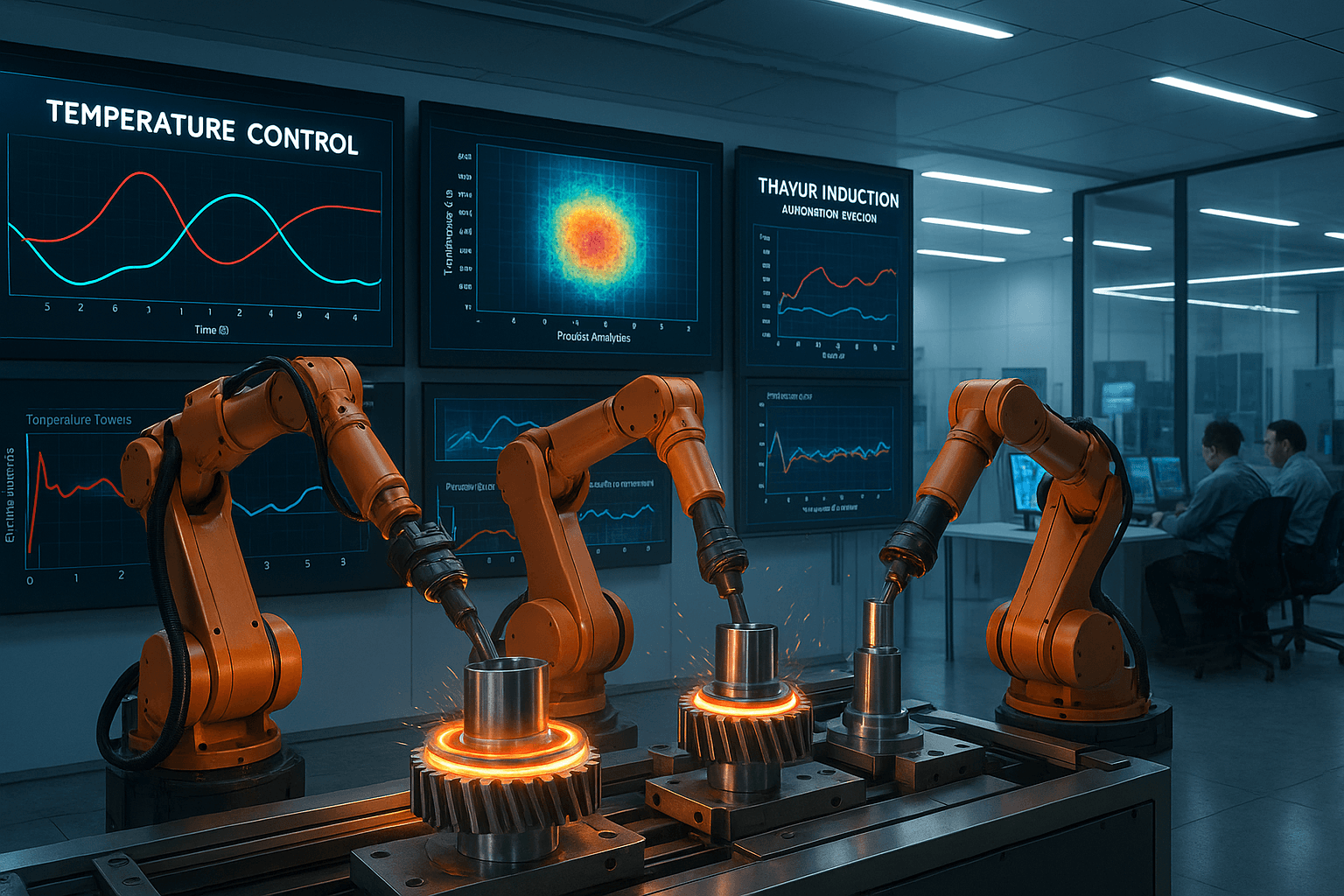
The induction hardening temperature for steel is typically the austenitizing range of 830–950°C: the surface is heated into this band, then quenched rapidly to form hard martensite. Lower-carbon grades like EN8 sit near 830–860°C, while alloy grades such as EN19, EN24 and 4140 run around 850–880°C — and holding within roughly ±5°C is what locks in the target hardness and case depth.
On this page
Target Hardening Temperatures
Induction hardening works by heating the surface of a steel component to its austenitizing temperature — the point at which the room-temperature ferrite/pearlite structure transforms into austenite — and then quenching it fast enough to form martensite. For most engineering steels that austenitizing window is 830°C to 950°C, with the exact figure set by carbon and alloy content.
Carbon raises hardenability but lowers the temperature needed to fully dissolve carbides into austenite, so higher-carbon steels are hardened toward the lower end of the band. Alloying elements such as chromium and molybdenum (present in EN19, EN24 and 4140) slow carbide dissolution, pushing the ideal austenitizing temperature slightly higher. The full thermal cycle moves through several stages:
| Stage | Temperature Range (°C) | Effect |
|---|---|---|
| Pre-heating | 200–400 | Reduces thermal shock |
| Austenitizing | 830–950 | Converts ferrite/pearlite to austenite |
| Quenching | Rapid cooling | Forms martensite (hard surface) |
| Tempering | 150–250 | Relieves stress and stabilizes hardness |
Because induction heating is so rapid, the practical austenitizing temperature is often nudged toward the upper part of a steel’s range to ensure full transformation in the short dwell time — but never so high that grain growth sets in. That trade-off is exactly why temperature control, not just temperature selection, decides the result.
Induction Hardening Temperature by Steel Grade
The table below lists typical austenitizing temperature ranges and achievable surface hardness for the steel grades we induction harden most often. Treat these as starting points: actual setpoints are refined per part geometry, case-depth target and your drawing specification.
| Steel Grade | Austenitizing Temperature (°C) | Typical Surface Hardness |
|---|---|---|
| EN8 (080M40) | 830–860 | 50–55 HRC |
| EN9 (070M55) | 820–850 | 55–60 HRC |
| EN19 (4140 / 709M40) | 850–880 | 52–58 HRC |
| EN24 (4340 / 817M40) | 850–880 | 52–56 HRC |
| 4140 alloy steel | 850–880 | 52–58 HRC |
| 20MnCr5 (case-hardening) | 860–900 | 58–62 HRC |
| Carbon steel (C45 / 1045) | 830–860 | 52–58 HRC |
For grade-specific guidance see our dedicated pages on EN8 steel induction hardening, EN19 steel induction hardening, EN24 steel hardening and 4140 steel hardening. Ranges in this guide are consistent with published heat-treatment data such as the ASM International heat treating references.
Why Precise Temperature Control Matters
Choosing the right temperature is only half the job — holding it is the other half. A swing of even ±20°C around the target can change case depth, peak hardness and the underlying microstructure. The most common temperature-related defects are summarised below.
| Error Type | Temperature Range Issue | Resulting Defect |
|---|---|---|
| Underheating (<830°C) | Insufficient austenitization | Low hardness, shallow case |
| Overheating (>950°C) | Excessive grain growth | Brittle surface, cracking |
| Uneven heating | Non-uniform heat zones | Distortion, hardness variation |
| Rapid temperature rise | High thermal stress | Surface cracking |
| Incorrect quenching timing | Delayed cooling | Soft surface or mixed microstructure |
Underheating leaves carbides undissolved and the surface only partly austenitic, so quenching produces a soft, shallow case. Overheating past roughly 950°C coarsens the austenite grain, leaving a brittle surface prone to quench cracking. Uneven heating — common on complex gear or shaft profiles — creates hardness variation and distortion. In every case the failure mode traces back to temperature that drifted outside the grade’s window during the brief induction cycle.
How Thakur Industries Monitors Temperature
At Thakur Industries, we combine technology, experience and metallurgy to hold temperature precisely through both the heating and quenching stages.
- Infrared Temperature Sensors: Real-time infrared pyrometers monitor surface temperature during heating with ±5°C accuracy.
- PLC-Based Automation: Programmable logic controllers continuously regulate power, frequency and heating duration based on material and geometry.
- Closed-Loop Control Systems: Feedback loops automatically adjust coil current and frequency to maintain the target temperature consistently.
- Digital Temperature Profiling: Every component’s heating profile is digitally recorded, ensuring traceability and repeatability — essential for OEMs.
- Predefined Recipes for Each Material: Each grade (EN8, EN19, EN24, 4140 and more) has a stored set of temperature parameters in our system for optimised hardening results.
Temperature Monitoring Tools We Use
| Equipment | Purpose |
|---|---|
| Infrared Pyrometers | Non-contact temperature measurement during heating |
| PLC Control Panels | Automated heat control and process timing |
| Digital Recorders | Real-time temperature logging |
| Thermal Cameras | Process visualization and hotspot detection |
| Thermocouples | Secondary verification of temperature accuracy |
This level of control is documented under our quality certifications and process controls, and it underpins the consistent hardness our customers across Ludhiana and Punjab rely on. For the wider thermal cycle, see our companion guide on the step-by-step induction hardening process and our overview of induction hardening services.
Need temperature-controlled induction hardening in Ludhiana?
Get a quote for grade-correct, temperature-monitored hardening of EN8, EN19, EN24 and 4140 components — with digital traceability on every batch.
Frequently Asked Questions
What is the induction hardening temperature for steel?
Most steels are induction hardened by heating the surface to their austenitizing temperature, typically between 830°C and 950°C, before rapid quenching. The exact figure depends on carbon and alloy content — lower-carbon grades like EN8 sit near 830–860°C, while alloy grades such as EN19, EN24 and 4140 run around 850–880°C.
What is the austenitizing temperature for EN8, EN19, EN24 and 4140 steel?
EN8 austenitizes around 830–860°C, EN9 around 820–850°C, EN19 (4140) and EN24 (4340) around 850–880°C, and 4140 alloy steel around 850–880°C. These ranges produce a fully austenitic surface layer that transforms to hard martensite on quenching.
What happens if the hardening temperature is too high or too low?
Underheating below the austenitizing range leaves the structure incompletely transformed, giving low hardness and a shallow case. Overheating above roughly 950°C causes grain growth, brittleness and a risk of cracking. Holding the correct temperature window is what guarantees the target HRC and case depth.
How tight is the temperature control at Thakur Industries?
Our induction hardening line in Ludhiana uses closed-loop infrared pyrometry and PLC automation to hold surface temperature within about ±5°C of the target, with every component's heating profile digitally logged for OEM traceability.
Conclusion: Precision Temperature = Perfect Hardness
The induction hardening temperature for steel comes down to landing inside each grade’s austenitizing window — roughly 830–950°C — and holding it there long enough to transform the surface without coarsening the grain. By selecting the correct setpoint per grade and maintaining it within ±5°C, Thakur Industries delivers uniform hardness, controlled case depth and dimensional accuracy on every part. Request a quote to discuss your component and material.